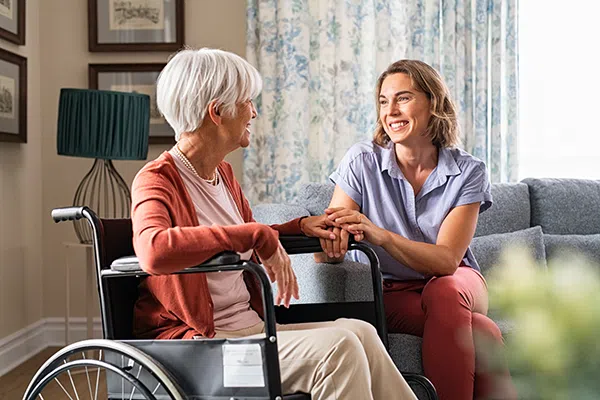

Roughly 63 million Americans provide ongoing, complex care for loved ones with medical conditions, disabilities, or frailty. And while many, but not all, family caregivers experience higher levels of mental, physical, and financial strain than non-caregivers, their needs are not always assessed. An original investigation by Wolff et al. (2020) found that 45 percent of older adult caregivers were never asked by health care workers whether they needed help managing care. When family caregivers receive needed services, such as training specific to the care recipient’s condition, not only do they have better outcomes themselves, but nursing home placements, hospital stays, and emergency room visits could be reduced for their care recipients.
NASHP’s 2025-2026 Family Caregiving State Policy Learning Collaborative is currently engaging 13 states to identify and advance best practices in supporting caregivers. Given that states fund, regulate, and administer services for caregivers, there is momentum at the state level to better reach out to caregivers, listen to them about their own needs, and improve support for them. A number of states are particularly interested in learning about caregiver assessments and how to use assessment data to better understand caregiver outcomes.
This brief highlights approaches to assessing family caregivers of older adults and people with disabilities in three Learning Collaborative states—Georgia, Illinois, and Wisconsin. These states presented at an in-person, state peer-to-peer meeting of the Learning Collaborative because they represented a range of different approaches. Georgia’s short assessment includes evidence-based measures; Illinois uses an evidence-based comprehensive tool and platform; and Wisconsin developed a checklist of items care managers can use to guide a conversation with the caregivers.
What Can Caregiver Assessments Do?
Family caregiver assessments can gather information about:
- The caregiver and the caregiving situation
- The caregiver’s perception of the health and functional status of the care recipient
- The caregiver’s values and preferences
- The health and well-being of the caregiver
- The impact of caregiving on the caregiver
- The caregiver’s skills, abilities, and knowledge
- Resources to support the caregiver
(Source: Family Caregiver Alliance)
Assessments can inform a care plan for the caregiver and follow-up through reassessment. Programs can use data from assessments to link caregivers to appropriate services, identify whether services and supports were provided, track caregiver outcomes over time, and inform continuous quality improvement.
Georgia’s Division of Aging Services uses the Bakas Caregiving Outcomes Scale within its non-Medicaid, home- and community-based services programs and the Older Americans Act-funded National Family Caregiver Support Program (NFCSP). The Bakas Scale measures enrolled caregivers’ changes in their well-being and health.
Through completing the scale, assessors can understand what types of caregiving responsibilities are causing stress and/or burden and create a service plan to address the caregiver’s needs. The state can also use caregivers’ scores as an outcome measure to examine whether caregivers using services are showing changes over time in their level of reported burden or stress.
Illinois uses the Tailored Caregiver Assessment and Referral (TCARE) system, which includes a person-centered assessment and development of a care plan for the caregiver. TCARE is an evidence-based proprietary assessment system used statewide in at least eight states, including Washington and New Hampshire. Within Illinois, all Area Agencies on Aging administer TCARE within the state’s NFCSP. Based on questions measuring caregiver relationships, health and well-being, training, self-perception, and other items, TCARE generates a care plan specific to the unique needs of the caregiver.
Through the platform, the state can collect a base of evidence to track changes in caregivers’ outcomes over time while using NFCSP services. Collecting TCARE data also allows the state to indirectly gauge caregivers’ intention to place care recipients in nursing homes by tracking levels of stress and depression and whether the caregiver feels comfortable with their identity as a caregiver. Illinois used TCARE to better understand the context in which caregivers were more vulnerable to placing care recipients in a nursing home.
Wisconsin uses a checklist-formatted needs assessment, administered by local aging units, in its NFCSP and the state’s Alzheimer’s Family Caregiver Support Program. Upon enrolling, all participating caregivers must complete the assessment to receive services. The assessor uses the checklist as a tool to guide discussions with the caregiver about their service needs. Wisconsin also collects pre- and post-program survey evaluation information from caregivers and administers the needs assessment at least annually.
By incorporating a conversational format, as well as a checklist, Wisconsin streamlines the assessment process to better understand what the caregiver’s needs are and target services.
Caregiver Assessment and Improved Outcomes
The benefits of caregiver assessments extend beyond data collection. Officials from Illinois and Wisconsin observed at the session that, after administering assessments and discussing support needs with caregivers, reported caregiver burden decreased.
- Georgia uses its assessment data to inform service plan development and match caregivers to specific interventions, referrals, and services tailored to their needs.
- Illinois found that 50 percent of caregivers who completed the TCARE assessment reported care recipients had significant memory loss. In response, the state provided supports to address caregiver burdens directly such as caregiver training and educational opportunities specific to Alzheimer’s disease, caregiver burnout, and support groups.
- Washington State analyzed data collected through TCARE assessments to demonstrate cost savings and a return on investment of caregiver supports, identifying trends in reduced hospitalization and delayed Medicaid long-term services and supports, alongside high levels of caregiver satisfaction.
- Wisconsin employed assessment data to identify program gaps and highest needs among their caregivers. The state applied this information to inform program development, including collaborating with partners to braid funding sources in efforts to improve the accessibility and utilization of caregiver support services.
Learn More
The National Caregiver Support Collaborative, funded by the U.S. Administration for Community Living, hosts the following new caregiver assessment resources:
- A Caregiver Assessment Checklist that provides guidance for states on what domains, training, and components are integral to a comprehensive assessment process.
- State profiles highlight approaches and promising practices to caregiver assessment. Featured state profiles include:
- Connecticut, which uses evidence-based measures to assess caregivers’ burden and depression.
- Pennsylvania, which uses an algorithm that calculates scores on its assessment items to identify caregivers with the most urgent need of services if a waitlist is instituted.
- Wisconsin, which uses a short checklist as a structure for holding conversations with caregivers about their needs (as described above).
NASHP is a proud partner of the National Caregiver Support Collaborative’s Technical Assistance and Coordination Center.
Acknowledgments
The Family Caregiving State Policy Learning Collaborative and this brief were made possible because of generous support from The John A. Hartford Foundation and the Ralph C. Wilson, Jr. Foundation. We thank state officials from Georgia, Illinois, and Wisconsin for their feedback, as well as staff of the Lewin Group.
This project is also supported in part by Administration for Community Living (ACL), U.S. Department of Health and Human Services (HHS) as part of a financial assistance award totaling $499,995.00. The contents are those of the authors and do not necessarily represent the official views of, nor are an endorsement, by ACL/HHS or the U.S. Government.