

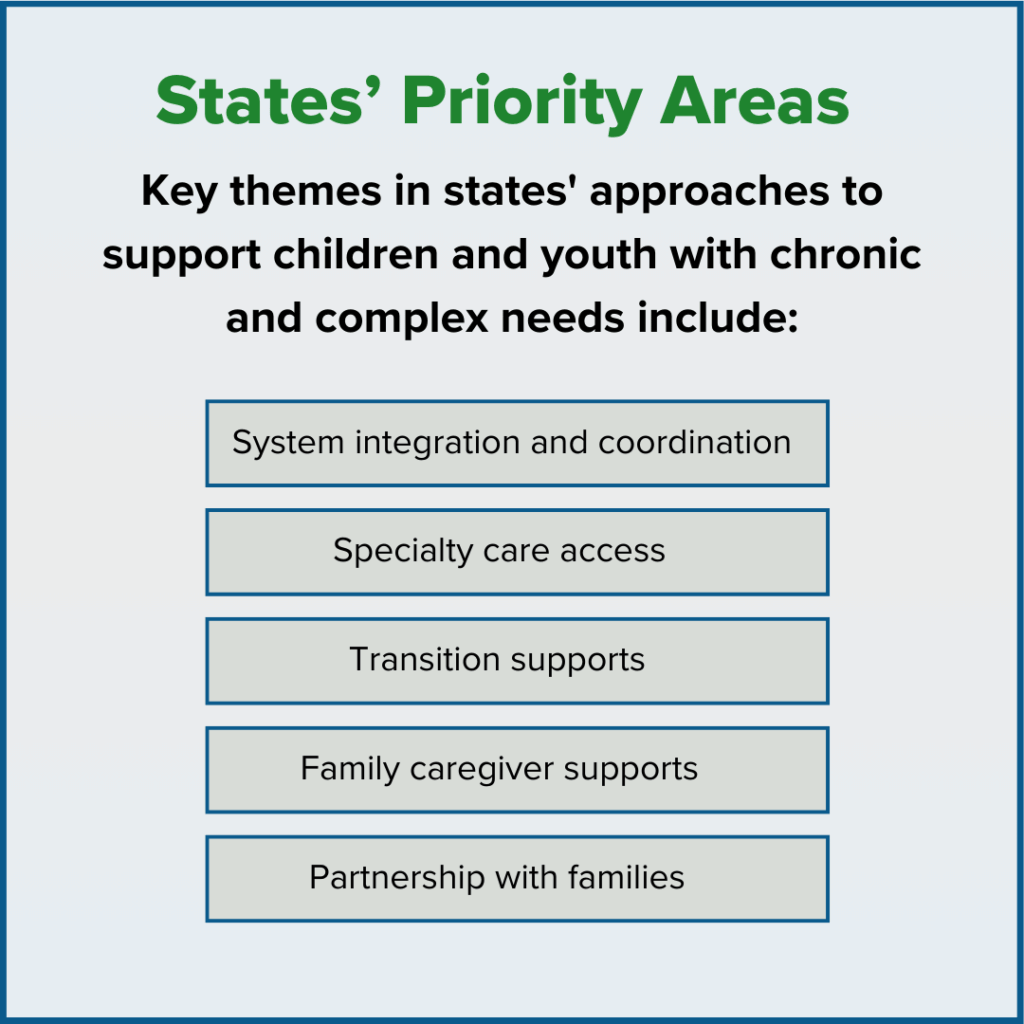
 Children and youth with chronic and complex needs, including disabilities, medical complexities, chronic illnesses, and behavioral health disorders, require specialized care that is often inaccessible due to fragmented systems and limited availability of services. From 2022 to 2023, only 13 percent of children and youth with special health care needs (CYSHCN) received care in a well-functioning system. Children with complex conditions experience even greater challenges, with only 11.7 percent reporting well-functioning systems. To improve systems of care for children and youth with chronic and complex needs, states are implementing an array of policies and leveraging various strategies — including legislation, demonstration projects and pilots, and programmatic changes — across Medicaid, public health, behavioral health, and other programs.
Promoting Integrated and Coordinated Care
Families often navigate complicated, fragmented systems to receive care, and over half of those with children and youth with more complex needs report frustrations in accessing services. To address these barriers, some states are working toward:
- Facilitating alignment and coordination across state agencies and providers
- Integrating financing, service delivery, and/or data collection and sharing
- Implementing new and enhanced Medicaid managed care arrangements that streamline systems
- Refining behavioral health continuums of care to make services accessible through various points of entry
- Providing direct care coordination and/or case management support, including through Medicaid and the Title V Maternal and Child Health (MCH) Services Block Grant
For example, Louisiana operates the Coordinated System of Care (CSoC), which streamlines financing and delivery of services for individuals ages 5 through 20 with significant emotional or behavioral health needs. The CSoC connects resources across the state’s child-serving agencies, including behavioral health, Medicaid, child welfare, education, and juvenile justice. Services are delivered and financed through one specialized Medicaid managed care plan and home- and community-based services 1915(c) waiver. This arrangement facilitates collaboration among state agencies and supports the exchange of funding and resources to meet families’ multi-system needs. Families are also paired with wraparound facilitators who conduct care planning and help coordinate across systems and providers. Eligible children and youth receive targeted services, including short-term respite care, youth support and training, and skills-building opportunities. Parents and caregivers can receive parent support and training services.
Facilitating Access to Specialty Care
Children and youth with chronic and complex needs experience persistent challenges obtaining the specialized services they require, often due to limited provider availability and physical access barriers. From 2022 to 2023, over one-third (39 percent) of CYSHCN reported some difficulties obtaining specialty care, while over half (56 percent) of children and youth with mental health conditions had some trouble accessing treatment or counseling. To improve access to specialty care, some states are:
- Expanding the pediatric workforce (e.g., recruitment and retention strategies, adopting paraprofessional roles, modifying training and certification requirements)
- Increasing Medicaid reimbursement for in-demand specialty services
- Financing interprofessional consultation through Medicaid and the Pediatric Mental Health Care Access Program
- Enhancing telehealth opportunities and flexibilities
- Conducting mobile clinics to meet families where they are
For example, the Alaska Department of Health operates Neurodevelopmental Outreach Clinics to connect families in rural and remote communities with neurodevelopmental diagnostic care. A pediatric neurodevelopmental specialist provides screenings and evaluations, diagnoses, patient education, and recommendations for follow-up treatment for children up to age 9. The clinic team also includes a patient navigator from Alaska’s family-to-family agency, which brings local knowledge and expertise as families navigate new diagnoses. The outreach clinic travels to rural hub locations across the state to provide specialty services for families who may not otherwise be able to physically access care.
Providing Services and Supports for Transition-Age Youth
As adolescents with chronic and complex needs enter adulthood and age out of pediatric service delivery systems, many experience challenges in transitioning to new providers, health benefits, and coverage. Yet, over 80 percent of youth ages 12 through 17 do not receive services to prepare for and move to adult care. Some states are working to improve access to transition supports by:
- Providing families with direct transition planning and coordination support (e.g., referral and connection to new providers)
- Selecting health care transition as a national performance measure to assess, monitor, and focus on through activities funded by the federal Title V MCH Services Block Grant
- Incorporating transition-specific services into Medicaid managed care programs
- Extending age limits on pediatric coverage and benefits to include young adults with chronic and complex needs
For example, Texas Medicaid’s STAR Kids managed care program provides acute care and long-term services and supports to children and young adults ages 20 and younger with disabilities and chronic health conditions. The STAR Kids contract requires managed care organizations (MCOs) to employ transition specialists who assist members and service coordinators with ongoing transition planning beginning at age 15. Families and young adults work with their service coordinator and transition specialist in preparing to transition from the pediatric to adult service delivery system and from STAR Kids to STAR+PLUS, Texas Medicaid’s managed care program for adults ages 21 and older with disabilities. Transition planning activities required in the STAR Kids contract include developing and regularly updating a member’s care plan with transition needs and goals, assisting the family and member in applying for adult supports, and identifying health care providers in the STAR+PLUS network for continuity of care.
Supporting and Compensating Family Caregivers
Family members of CYSHCN provide nearly 1.5 billion hours of health care per year. These caregivers often experience health, social, and financial hardships associated with stress, isolation, and missed employment opportunities. Some states are supporting family caregivers of children and youth with chronic and complex needs by:
- Adopting and implementing Medicaid reimbursement for personal care or nursing services delivered by family members
- Creating flexibilities to self-direct care and identify and pay family members or other selected individuals as providers
- Financing and expanding respite care through Medicaid programs, state respite coalitions, public health departments, and aging and disability agencies
- Providing specific trainings and supports (e.g., peer support, navigation assistance) for family caregivers
For example, Delaware Medicaid allows families of children and youth with medical complexities, intellectual and developmental disabilities, and/or behavioral health conditions to self-direct personal care services (e.g., bathing, dressing, personal hygiene, housekeeping, etc.). Approved through the Diamond State Health Plan (DSHP) Section 1115 demonstration waiver, this flexibility enables parents to hire a legally responsible family member as a service provider. This is paid for through MCOs and the financial management service agencies that contract with the MCOs. In addition, the DSHP demonstration includes a pediatric respite benefit to provide structured support and breaks for caregivers of children and youth with chronic and complex needs. Delaware covers three types of respite based on the level of care required, provider qualifications, and setting (in-home or in a community setting or licensed facility).
Engaging Families as System Partners
Among families of children and youth with more complex health needs, nearly 18 percent report sometimes or never feeling valued as partners in making decisions about their child’s care. To support family-centered and family-driven care, some states are prioritizing opportunities to include families in shaping and designing systems. Strategies include:
- Coordinating advisory committees, councils, and boards in which families can provide meaningful input on child-serving systems and policy change
- Hiring individuals with lived experience being or caring for a child with chronic complex needs in state-level positions to shape systems of care
- Creating and financing roles (e.g., peer support professionals) for community members with direct experience to provide care or support youth, parents, and families in navigating systems
For example, the Pennsylvania Department of Health, with funding from the Title V MCH Services Block Grant, operates the Family Impact Initiative, a partnership between state and local health departments, providers, and families to improve systems of care for youth with chronic and complex needs. Through the program, parents lead an advisory committee that identifies local opportunities and policy levers to advance the health of CYSHCN. The initiative also employs a parent advocate to lead and provide key input. Efforts and areas of focus have included resources for families on navigating and accessing services, transition supports, provider trainings on serving children with complex needs, and accessible outdoor spaces for children with disabilities. The Department of Health is currently piloting the initiative in Philadelphia County and exploring opportunities for expansion.
Policy Considerations Moving Forward
State policies and activities reflect a focus on streamlining systems, improving access to services, and centering families in care. As states continue to pursue efforts to ensure access to care, they can consider the National Standards for Systems of Care for CYSHCN and National Care Coordination Standards for CYSHCN, which outline key components of systems of care for CYSHCN. Additionally, the Blueprint for Change can provide a framework for states to create systems that meet the social, health, and emotional needs of children and youth.
Acknowledgments
Many thanks to Karen VanLandeghem and Robin Buskey for contributing to this resource by leading state-to-state discussions and offering review. NASHP also extends its sincere thanks and appreciation to the individuals at the state and national levels who supported this work and shared and/or reviewed the examples included.
Support for this work was provided by the Lucile Packard Foundation for Children’s Health. The views presented here are those of the authors and do not reflect those of the Foundation or its staff. The Foundation’s Program for Children with Special Health Care Needs invests in creating a more efficient and equitable system that ensures high-quality, coordinated, family-centered care to improve health outcomes for children and enhance quality of life for families. Learn more on the Foundation’s website.