People experiencing homelessness are at increased risk of opioid overdose and face additional barriers to accessing substance use treatment and supports compared to the general population. Improving access to treatment and stable housing opportunities for this population requires resource alignment across federal, state, and local sources and across the housing capital, rental assistance, and services sectors. Chronic (and increasing) shortages in affordable housing and behavioral health services also contribute to challenges.
To address this gap, states are pursuing braided funding approaches, including leveraging opioid settlement funds, to strategically invest in an array of housing and wraparound services options. Coordinated efforts to advance a comprehensive strategy for housing across state agencies and with local partners can ultimately contribute to a reduction in overdoses and use of costly acute care services for people with substance/opioid use disorder. The following is an overview of how states can invest opioid settlement dollars across different types of housing supports for people with substance use disorders (SUD) and opioid use disorders (OUD), along with specific state examples.
Background
Promoting housing stability among individuals with substance use disorders, including opioid use disorder, relies on an array of housing supports that address a range of needs. As such, the continuum of housing supports varies in terms of entry requirements, duration, and intensity of services. Figures 1 and 2 outline some of the most common housing models.
State, federal, and local partners are investing in various models along that continuum including primarily: 1) supervised residential settings, such as recovery housing models, that are focused on long-term recovery from substance use and co-occurring disorders; 2) permanent supportive housing (PSH) options, an evidence-based practice in which housing assistance and supportive services are provided to assist households with achieving housing stability; and 3) transitional housing, which is time-limited supportive housing designed to be an intermediate step before one transitions to permanent housing.
The housing continuum in Figure 2 shows the range of housing types typically available in a community — corresponding to different individual service needs and other factors. Additional elements such as eviction prevention resources, access to medication for opioid use disorder, recuperative care or respite settings for post-inpatient recovery, and rapid rehousing programs are all important components of a comprehensive array of housing supports.
Figure 1: Types of Housing Models
Figure 2: Continuum of Housing Supports
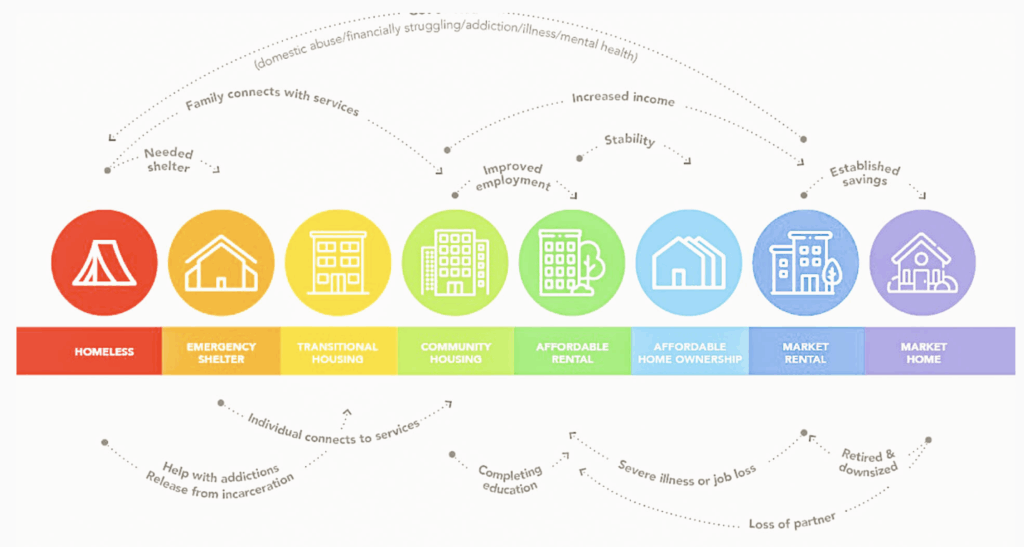
Source: United Way Halifax
Leveraging Opioid Settlement Funding across the Continuum of Housing Supports
Funding from opioid-related lawsuits, totaling over $55 billion, is currently being distributed to states and localities to support strategies that abate the opioid crisis. Though each state has a unique process for distributing settlement funds, and may make funding decisions based on opioid-related needs across communities, the funding may offer a unique resource for states seeking to braid funds toward a housing intervention for individuals impacted by substance use. Exhibit E, which lists allowable opioid remediation uses under the terms of the national opioid settlement agreements, identifies several elements of the housing support continuum as approved uses for settlement dollars (See Figure 3 for additional details).
Figure 3: Housing options as allowable uses of opioid settlement funding
Approved Uses
- Provide comprehensive wraparound services to individuals with opioid use disorders (OUD) and co-occurring substance use disorders/mental health (SUD/MH), including housing, transportation, and childcare
- Provide the full continuum of care of treatment/recovery services for OUD and co-occurring SUD/MH, including supportive housing, peer support, and navigation
- Provide access to housing for people with OUD and co-occurring SUD/MH, including supportive housing, recovery housing, housing assistance programs, training for housing providers, or recovery housing programs that allow or integrate FDA-approved medication with other support services
- Provide for peer support specialists or recovery coaches in recovery housing and other settings
- Fund additional positions and services, including supportive housing and other residential services, relating to children being removed from the home due to custodial opioid use
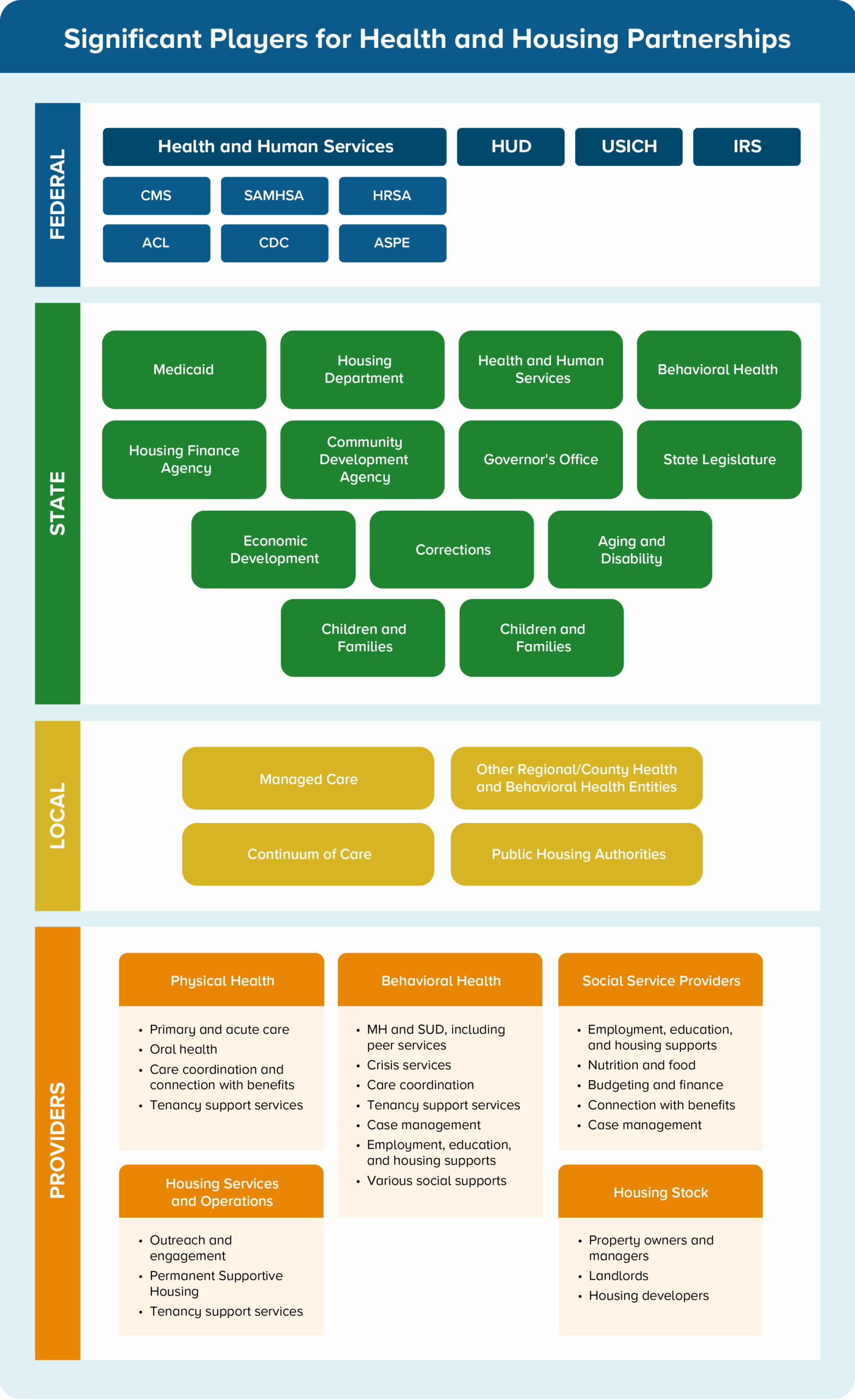
Resources for housing development, operating costs, and supportive services are funneled through a variety of governmental and quasi-governmental entities. Many states already operate a coordinated, strategic funding approach across partners and programs – which can be harnessed for smart investments. (Figure 4 outlines some of the key players in this space.) Some states that have chosen to invest settlement funds in housing strategies are coordinating across existing collaborations with federal, local, and provider-level partners to understand gaps in needs and how states may braid settlement funding with other funding sources to support a comprehensive housing strategy.
Figure 4: Significant Players for Health and Housing Partnerships
Examples of States Investing Settlement Funds in Cross-Agency Approaches to Housing
Over the past several years, many jurisdictions have made settlement investments in housing programs. These investments have included capital investments (such as purchase of property or expansion of or improvements to existing properties), funding for supportive services to help with connecting individuals to resources, and rental assistance targeted toward individuals with SUD/OUD. Given their more flexible use, opioid settlement funds could be aligned with federal and state funding streams to fill in any gaps in housing supports, ensuring adequate resource availability.
Below are several state examples of collaborative approaches to investing opioid settlement funding in housing. Additional information on each state’s individual opioid settlement spending and processes can be found in NASHP’s State Opioid Settlement Spending Decisions tracker.
Connecticut
The Connecticut Opioid Settlement Advisory Committee (OSAC), responsible for overseeing the allocation of opioid settlement funds, established a process to determine how opioid settlement funding is spent, which includes collecting public input. This process identified housing as a key priority, prompting the committee to leverage the expertise of the Department of Mental Health and Addiction services (DMHAS) and the Connecticut Department of Housing (DOH) to identify how an opioid settlement-funded initiative could complement existing programs. Upon reviewing internal data and gaps in current services, the committee recommended a variety of strategies that target individuals who are experiencing homelessness, unstably housed, or who are returning from a residential treatment service with OUD but do not meet the federal Department of Housing and Urban Development’s criteria of homeless and thus do not qualify for a number of the state’s existing resources for people experiencing homelessness.
From those recommendations, the DMHAS was allocated $58.6 million in settlement funding over four years to support the HERO (Housing Empowering Recovery from Opioids) program. The project provides funding for housing subsidies that will be administered through the State of Connecticut Department of Housing’s Rental Assistance Program, client supports funds that can cover expenses, such as security deposits or furniture, and trauma-informed case management services.
Illinois
In 2022, Illinois published a state Overdose Action Plan informed by the Illinois Opioid Crisis Response Advisory Council to understand existing state accomplishments and identify and prioritize recommendations to reduce overdose deaths in the state. The Illinois Office of Opioid Settlement Administration is responsible for administering 55 percent of opioid settlement funds the state received — and prioritizes proposals that align with the core strategies in the Overdose Action Plan.
The Office of Opioid Settlement Administration received a proposal to create permanent supportive housing units across the state and devoted $20 million to this effort. To carry out the unit development, the state leveraged an existing annual request for applications (RFA) process overseen by the Illinois Housing Development Agency (IHDA). The RFA for the PSH round also includes a mix of state and federal funds based on what is available. In 2025 the funding opportunity includes an allocation of the opioid settlement funds for qualifying developments that provide supportive housing targeted to individuals living with substance use disorders and/or co-occurring disorders and who are also currently experiencing homelessness or chronic homelessness.
Developments that qualify for the use of opioid settlement funds must meet additional requirements, including that it use a harm reduction approach, target specific geographic areas prioritized by the state, include an onsite space where individuals can receive services, and have an ability for individuals to pay no more than 30 percent of their income to live there.
Indiana
The Indiana Family and Social Services Administration’s (FSSA) Division of Mental Health and Addiction collaborated with fellow state agencies to develop a multi-year distribution plan for the state’s restricted opioid settlement funds. After a prior settlement-supported grant program received many applications for recovery residences, the state recognized the need for additional funding opportunities specific to housing projects. As a result, in their most recent two-year distribution plan for state opioid settlement funding, the FSSA partnered with the Indiana Housing and Community Development Authority (IHCDA) to allocate $10 million to develop four affordable rental housing developments with wraparound supportive services for individuals with SUD. IHCDA released a request for proposals, and applicants were selected based on operating “under one of the following models: (1) permanent supportive housing utilizing housing first principles, (2) transitional housing with time limits on occupancy, or (3) Level II, Level III, or Level IV recovery housing residences.” Operating costs and supportive services will be funded through other available sources.
Michigan
Michigan’s Department of Health and Human Services (MDHHS) is responsible for distributing funding from the Opioid Healing and Recovery Fund. The state’s Opioids Task Force identified several priorities for future settlement-funded initiatives, one of which includes increasing the number of recovery and long-term housing solutions. The state drew from various data sources to understand the need for housing. According to a recently published needs assessment, at least one in five fatal overdoses in Michigan had a history of housing instability, and the rate of fatal overdoses among people experiencing homelessness is 16 times higher than those with no recent history of housing instability.
To address these housing needs, the state allocated $2.5 million in settlement funding toward the Recovery Housing Investment Program, which is operated in partnership with the Michigan State Housing Development Authority and aims to expand access to recovery housing for people with OUD and co-occurring SUD or mental health conditions. The opportunity funds recovery residences in areas of the state where recovery beds are most needed, allowing funding to be used for property acquisition, furnishings and improvements, or operating and administrative costs. Michigan’s Recovery housing and permanent supportive housing initiatives are expected to continue in 2026.
For More Information:
NASHP’s Health and Housing Work
For more resources specific to health and housing, see the following:
- NASHP Medicaid and Housing Toolkit
If you or other state official colleagues are interesting in joining the health and housing learning community, or would like to learn more about NASHP’s housing-related work, reach out to swilkniss@nashp.org.
NASHP’s Opioids and Substance Use Work
For more resources specific to opioids and substance use disorder, see the following:
- State Policy Center for Opioids and Substance Use Disorder
- Resource Page: How are States Using Opioid Settlement Dollars?
- Tracker: State Opioid Settlement Spending Decisions
Acknowledgments
This publication was made possible by the ongoing support of the Foundation for Opioid Response Efforts (FORE). The authors would also like to thank the state leaders who have reviewed this publication.