As the opioid crisis continues to evolve, efforts to educate communities on the dangers of substance use and resources on overdose prevention are needed to curb rising rates of drug-related overdoses. Driven by the increased lethality of fentanyl in the drug supply, adolescent overdose deaths more than doubled between 2019 and 2021, even as the rate of adolescent drug use remained steady.
According to the Substance Abuse and Mental Health Services Administration, substance use prevention “seeks to prevent problems before they start [by] preventing exposure to substances (or screening and intervening with early misuse), reducing risk factors, and strengthening protective factors at the individual, relationship, community, and society levels. Prevention also seeks to stop or delay the progression of substance use to a substance use disorder, as well as prevent other harms associated with substance use.”
By investing in prevention strategies as a part of a larger, multilayered approach to addressing substance use, states can work to decrease individual and environmental risk factors that lead to substance use and provide individuals with tools to reduce substance-related harms. Connecticut has advanced a comprehensive strategy for substance use prevention at the state and community level, with the state’s Department of Mental Health and Addiction Services (DMHAS) supporting a statewide prevention infrastructure for community-level prevention efforts.
State Leadership on Prevention
To guide the state’s vision and priorities for substance use prevention, Connecticut’s DMHAS funds a variety of organizational structures and efforts for resource dissemination and evaluation work. Prevention efforts in Connecticut are funded by blending and braiding prevention-related federal grants, including State Opioid Response grants; Substance Use Prevention, Treatment, and Recovery Services block grants; and other discretionary funding, allowing for state partners to expand and build upon effective programs.
Connecticut’s Opioid and Drug Use Crisis
- In 2022, Connecticut’s drug-induced mortality rate was 40.3/100,000, compared to the national rate of 35/100,000.
- Over 8.5% of Connecticut high school students reported taking prescription pain medications without a prescription or differently than prescribed.
- DMHAS leads state programs and guides funding related to mental health and substance use.
- Connecticut will receive approximately $300 million in opioid settlement funding, with an advisory committee tasked to disperse 85% of total funding.
- Prevention is one of six funding priorities to be considered by the advisory committee when allocating settlement funding.
Offering a variety of resources, educational methods, and training opportunities about substance use prevention allows for a multi-layered and culturally informed approach for engaging communities in prevention. Connecticut maintains a resource library and a technical assistance center dedicated to prevention and other substance use subjects, with resources available in multiple languages and formats to maximize accessibility. The Connecticut Clearinghouse houses fact sheets, data and screening tools, and links to additional programming for all topics within the substance use and mental health care continuums, while the Prevention Training & Technical Assistance Service Center offers training modules, workshops, and other professional development opportunities for the prevention workforce and other community members.
Because prevention addresses upstream factors that can contribute to health outcomes, immediate impacts of investments can be difficult to measure. Having structures in place to evaluate existing efforts and inform future efforts is important to ensure effectiveness of initiatives and ability to adapt programming to emerging areas of need. In Connecticut, the Center for Prevention Evaluation and Statistics, which supports DMHAS’ Prevention and Health Promotion Division evaluation efforts, collects and analyzes data related to substance use prevention and health disparities. The Prevention Data Portal houses these published data, with options to filter data sets by geography, year, and keywords. These evaluation capabilities, along with a Local Evaluator Workgroup whose members assess prevention initiatives at the local level, help the state to tailor current and future initiatives related to prevention.
Connecticut has built a strong and sustainable infrastructure to serve as a foundation to implement effective prevention and positive behavioral health across the lifespan. DMHAS recognizes that prevention does not happen in a vacuum and requires building trusted relationships and developing deep-rooted partnerships. In addition to fostering these important relationships, Connecticut uses innovative and creative ways to engage partners in prevention that are hard to reach. Prevention starts with small steps, yet has a big impact.
Supporting Prevention at the Local Level
Community coalition prevention models strengthen collaboration at the local level by bringing together partners across different sectors (health, education, law enforcement, business) to address environmental factors that can contribute to substance use and address community-specific challenges.
In Connecticut, there are two bodies in charge of coordinating and funding prevention-related initiatives at the local level. DMHAS provides oversight and funding to the Regional Behavioral Health Action Organizations (RBHAOs). These five regional organizations are responsible for a range of planning, education, and advocacy of behavioral health needs for children and adults. The RBHAOs assess and report on recommendations for behavioral health needs, raise awareness of relevant topics at the community level, and leverage funding to support mental health and substance use prevention and reduction efforts across their respective region. For example, since 2019, the RBHAOs have trained over 16,000 individuals in recognizing an overdose and administering naloxone and distributed over 18,000 naloxone kits.
RBHAO Regional Map
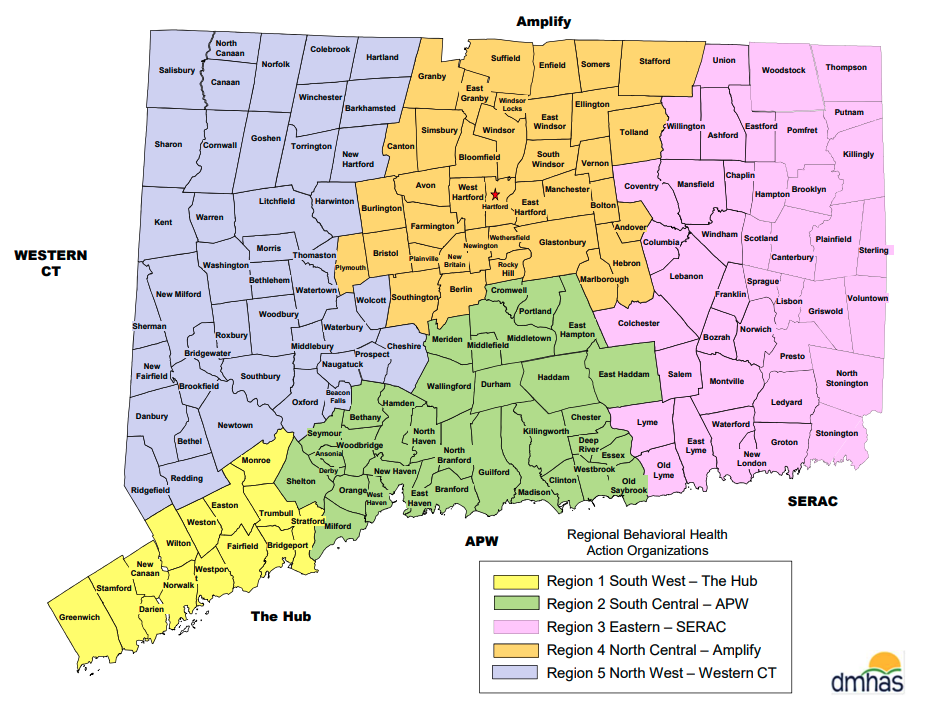
Additionally, the RBHAOs support over 150 Local Prevention Councils, which are local municipality and town councils that work to increase awareness and fund initiatives related to alcohol, tobacco, and other drug prevention at the community level. Local Prevention Councils can apply for funding administered by the RBHAOs, with a recent grant opportunity including funding to build capacity for opioid addiction and overdose prevention efforts, in which Connecticut administered 40 mini grants to Local Prevention Councils.
Promoting Public Awareness and Education
One key strategy for preventing harmful effects from substance use is promoting public awareness of dangers and emerging threats related to substance use, conveying best practices for preventing substance use, and sharing related resources. This can be done through public messaging campaigns, offering educational materials and resources, or establishing partnerships for messaging and resource dissemination. Tailoring information based on audience and need ensures the messages are received by disproportionately affected populations.
Connecticut supports a variety of educational programming that targets different populations and focus areas. The Change the Script campaign, an effort to deter prescription drug and opioid misuse, works to inform the public about opioid misuse and encourage safer practices to help prevent overdoses. The website houses a digital toolkit of educational materials as well as the option to order free resources such as medication disposal bags or lock boxes. To assist in resource dissemination outside the online format, the campaign also offers a resource mobile van that can be booked for different events or areas across the state. The van delivers resources such as pamphlets, fact sheets, and medication storage or disposal units directly to communities in need.
Connecticut uses creative and innovative ways to connect and engage young audiences with a style and messages that resonate and prompt them to reconsider the risks of substance use — two additional campaigns, Be In The Know Cannabis CT and KnowUrVape, highlight this approach.
An additional program, the Healthy Campus Initiative, works to reach a more specific population with prevention curriculum. This effort to increase awareness of the opioid crisis within higher education institutions, supported by State Opioid Response grant funding, funds 18 institutions across the state to carry out projects, including training students and teachers on naloxone usage, discussing the dangers of fentanyl and other emerging threats, and administering surveys to assess risk among student populations. The initiative engages over 60,000 students and staff, contributing to DMHAS’ goal of reaching all populations across the lifespan with prevention interventions.
Empowering Youth
Programs to empower and mentor youth work to address underlying risk factors that lead to substance misuse and help build up protective factors, including development of healthy coping mechanisms and expanding support systems. When youth populations have trusted adults to turn to, they can build confidence in making healthy lifestyle decisions.
Founded in 1989, Connecticut’s Governor’s Prevention Partnership effort focuses on training youth and adult populations on the risks of substance use along with development of broader communication and social awareness skills. Through a variety of mentorship programs, youth can partner with trained adults who educate on various life skills, assist in the development of healthy coping mechanisms, and stand as a trusted resource and role model to help deter substance use. This effort strives toward the ultimate goal of empowering youth and expanding support systems as a means of substance use prevention.
Key Takeaways
As the presence of fentanyl continues to drive youth overdose death rates, states are developing multilayered strategies to effectively provide youth with education and resources related to substance use. Connecticut’s approach to prevention promotes a strong vision and support for prevention efforts at the local level, educational and training programs to reach a variety of populations, resources to connect populations to the greater continuum of care, and methods to evaluate impact of prevention initiatives.
Though it takes time to develop and build capacity within each component of prevention infrastructure, the pieces collectively work toward the goal of decreasing substance use harms. Opioid settlement dollars, along with other substance use-related funds, give states an opportunity to invest in systems to support youth populations and improve long-term substance use outcomes.
Acknowledgments
The National Academy for State Health Policy provides this information with the ongoing support of the foundation for Opioid Response Efforts (FORE) and thanks FORE Project Officer Ken Shatzkes and FORE President Karen Scott for their continued guidance and direction. The authors would also like to thank Sarju Shah and Kelly Sinko for their contributions to this publication.