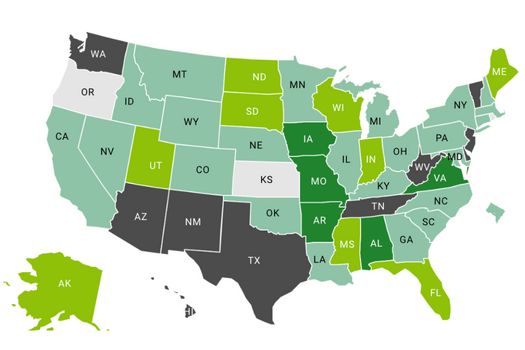

This information was collected through a combination of state surveys and NASHP staff research. It offers a snapshot of how the state is defining, training, certifying, and paying for the CHW workforce — as well as how the state is developing cross-agency and state-to-local strategies to improve community health in partnership with CHWs.
This is a dynamic policy space, and states are continuing to develop new approaches. We will continue to make periodic updates to this page. Learn more about state CHW policies across the U.S.
State CHW Definition
Information is unavailable.
State CHW Governance
There is currently no dedicated state office of CHWs. The North Dakota Department of Health and Human Services will handle certification and regulation of CHWs once administrative rules are implemented.
Certification and Training
In 2023, HB 1028 was enacted and mandated that the North Dakota Department of Health and Human Services (HHS) would establish and implement a method for certifying CHWs, which also includes certification of Community Health Representatives (CHRs) as CHWs. Based on recommendations from the state’s CHW Task Force, HHS will propose administrative rules for certification and regulation of CHWs thereafter. CHRs must complete Indian Health Service standard and targeted case management course.
Medicaid Reimbursement
North Dakota reimburses Tribal CHRs through the Medicaid State Plan for targeted case management for members in need of long-term care services. Medicaid reimburses the Tribal CHRs through the code T1023 at $519 per encounter (daily rate).
North Dakota does not currently authorize Medicaid reimbursement for CHW services. ND HB 1028 requires the department of health and human services to seek a State Plan amendment between the 2023 and 2025 biennium to reimburse for CHW services.
Other Funding or Financing Mechanisms
Information is unavailable.
Key Partnerships
The CHW Task Force (created to facilitate implementation of provisions of HB 1028) collaborated with North Dakota Department of Health and Human Services to draft administrative rules regarding scope of practice, training and certification, Medicaid state plan amendment language, and a plan for a CHW Collaborative in the state.
State CHW Legislation
HB 1028 was enacted in 2023 and establishes a requirement for CHW certification in the state. The legislation also established a CHW Task Force to propose plans for additional CHW programming and Medicaid reimbursement in the state. The taskforce completed planning in December 2024, and the North Dakota Department of Health and Human Services will draft CHW Administrative Rules for CHW Training, Certification, and Regulation, and the Medical Services Division will prepare a State Plan Amendment for CHW coverage as preventive services using the Task Force’s final recommendation.
State Resources
ACO – Accountable care organization
AHEC – Area Health Education Centers
APHA – American Public Health Association
APM – Alternative payment model
CBO – Community-based organization
CDC – Centers for Disease Control and Prevention
CDC CCR Funding – Community Health Workers for COVID Response and Resilient Communities Funding
CHR – Community health representative
CHW – Community health worker
CPT Codes – Current Procedural Terminology Codes
C3 Project – CHW Core Competency Project
FFS – Fee for services
HCSPCS Codes – Healthcare Common Procedure Coding System Codes
HRSA – Health Resources & Services Administration
MCO – Managed care organization
NACHW – National Association of Community Health Workers
SDOH – Social determinants of health
VBP – Value-based payment
State CHW Definition: This category indicates where states have a formal definition of a CHW. In some cases, where there is not a definition in statute, this category may draw information from provider manuals and state websites or reports.
Certification and Training: This category includes information about how CHWs are trained in the state, which entities provide training, whether or not the state runs or recognizes a CHW certification program, and information about the entities that administer existing certification programs.
Medicaid Reimbursement: This category includes information about state Medicaid strategies that provide enrollees access to CHW services. Entries indicate whether state Medicaid programs currently reimburse for CHW services or incorporate CHWs into alternative payment models under the authority of a state plan amendment (SPA), or where states have earmarked funds to support CHW services under the authority of an 1115 demonstration waiver. It also indicates where CHW services might be supported through managed care approaches (e.g., where MCOs are paying for CHW services using administrative dollars or where states are using managed care contracts to incentivize or require MCOs to cover CHW services).
Other Funding or Financing Mechanisms: This category includes information about other state funding or financing approaches that cover CHW services or CHW positions. It includes information about federal grant dollars for which the state is the grantee.
Key Partnerships: This category offers information about key partners outside state government, including state CHW associations and CHW training entities, and highlights formal cross-agency partnerships within the state that support alignment of funding and resources for the CHW workforce.
State CHW Legislation: This category highlights any state legislation relevant to the CHW workforce. This might include statutory language directing agencies to develop a Medicaid reimbursement approach, laws that established state CHW certification, or other relevant statutes.
State Resources: This category offers links to any key reports or resources that states elected to highlight as critical to CHW policy and partnership.