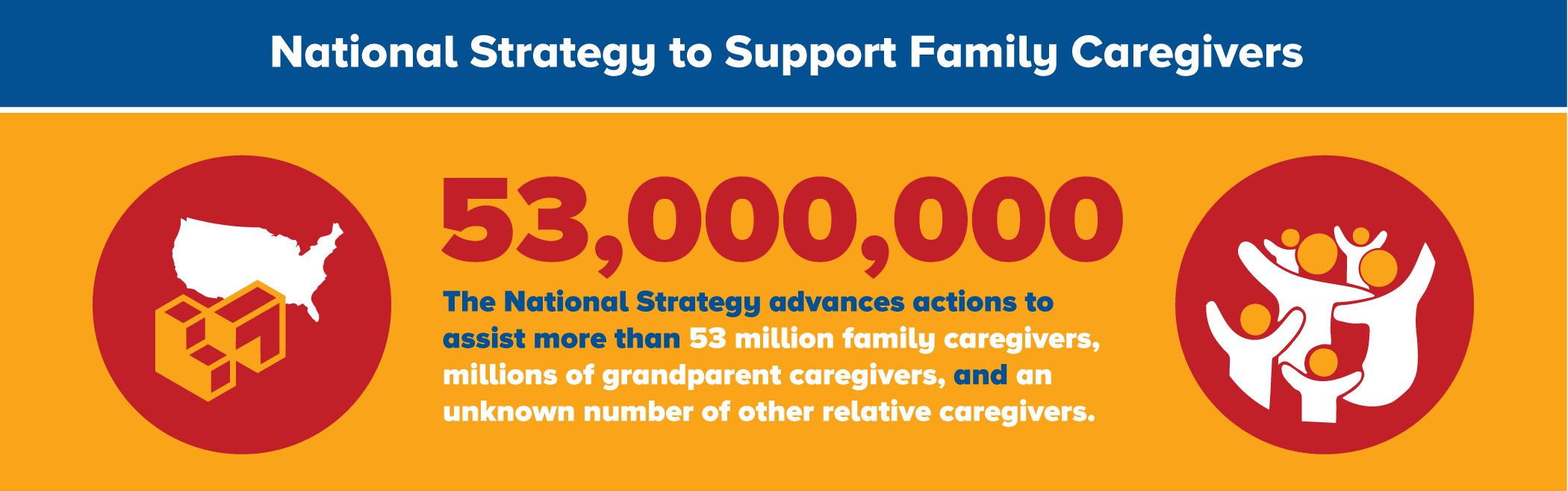
This Report highlights some of the initial impacts of the National Strategy on states, communities, providers, employers, and others in assisting the 53 million family caregivers, millions of grandparent caregivers, and an unknown number of other relative caregivers. This piece serves as a companion to the Federal Progress report published by the Administration for Community Living (ACL) on implementing the National Strategy, which showcases the significant progress 15 federal agencies have made in increasing support for family caregivers. Although the National Strategy is a catalyst for strengthening support to family caregivers, more work needs to be done. Results from a recent National Poll on Healthy Aging showed that most older adults do not know about the resources available to them or their caregivers.
To increase awareness of the vital role of caregivers, the first-of-its-kind National Strategy to Support Family Caregivers lists hundreds of actions that federal agencies, state and local governments, businesses, and communities can take to improve their lives.
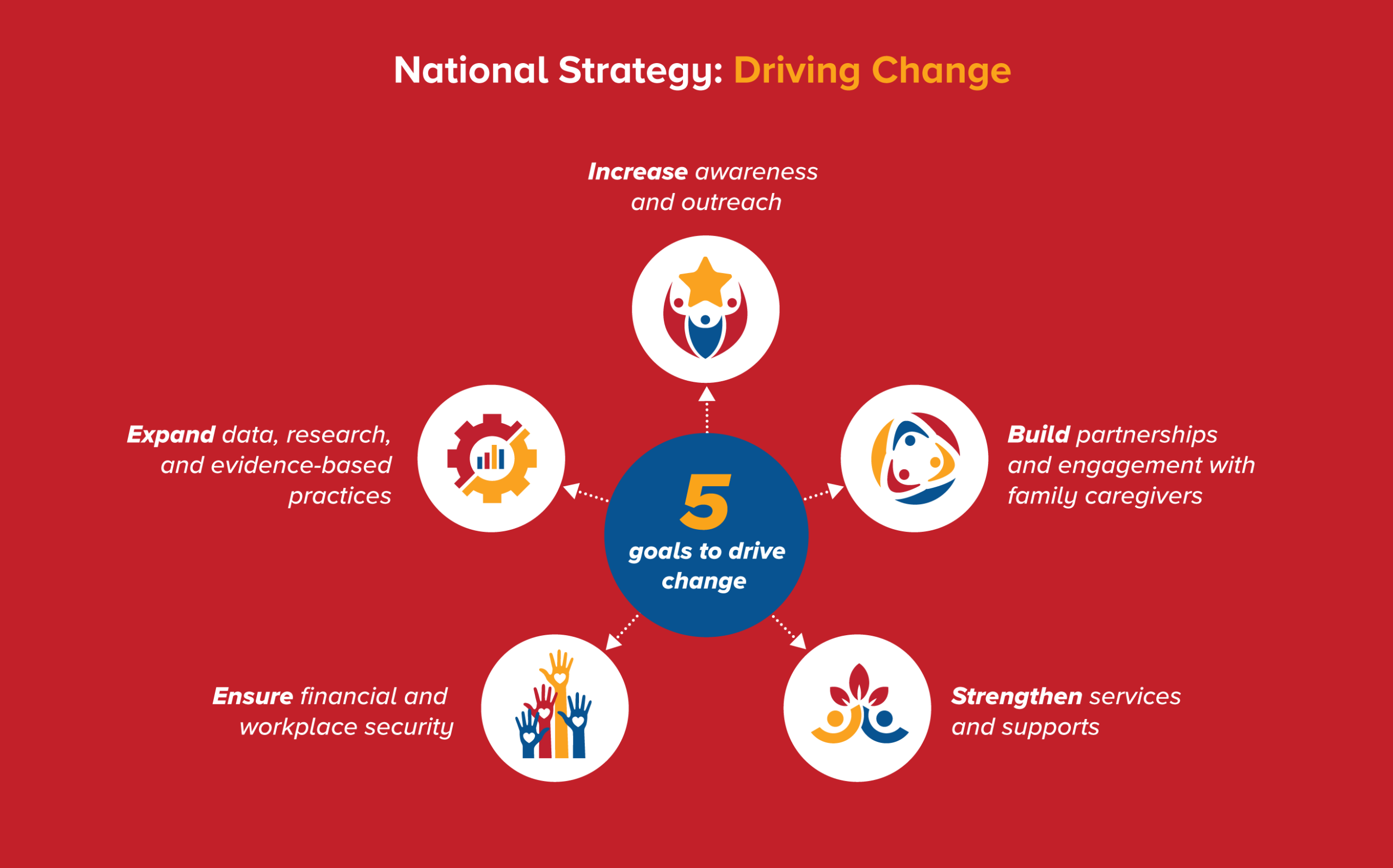
To drive change, the Strategy describes five goals:
Increase awareness and outreach
Build partnerships and engagement with family caregivers
Strengthen services and supports
Ensure financial and workplace security
Expand data, research, and evidence-based practices
Impact by the Numbers
Wide array of voices impacted the National Strategy.
The National Strategy was developed with extensive input from federal agencies, national and community-based organizations, academics and caregivers, making long-term policy change more inclusive and feasible.
1,613 caregivers and organizations responded to a federal request for information to share their recommendations.
800 recommendations from 27 major family caregiving reports were collected, analyzed, and synthesized.
150 organizations and 80 family caregivers from across the country participated in listening sessions to inform the National Strategy.
26 caregivers shared their stories in the initial report to Congress and are on the cover of this report.
15 federal agencies participated in advisory councils or identified specific actions they would take to better support family caregivers.
“What makes the difference is that there are so many people who care about this and are talking about the National Strategy to Support Family Caregivers”
Lynn Gall, Wisconsin Bureau of Aging and Disability, RAISE Council member
“Counties across the nation are actively supporting aging and caregiver services, and the National Strategy serves as a springboard for counties to participate more directly in those systems.”
Annie Qing, National Association of Counties
“RAISE was a signal moment. Prior to it, there had been no national approach to recognize and support family caregivers.”
Rani E. Snyder, The John A. Hartford Foundation
FUNDING
National Strategy Aligns Investments and Initiatives in Caregiving
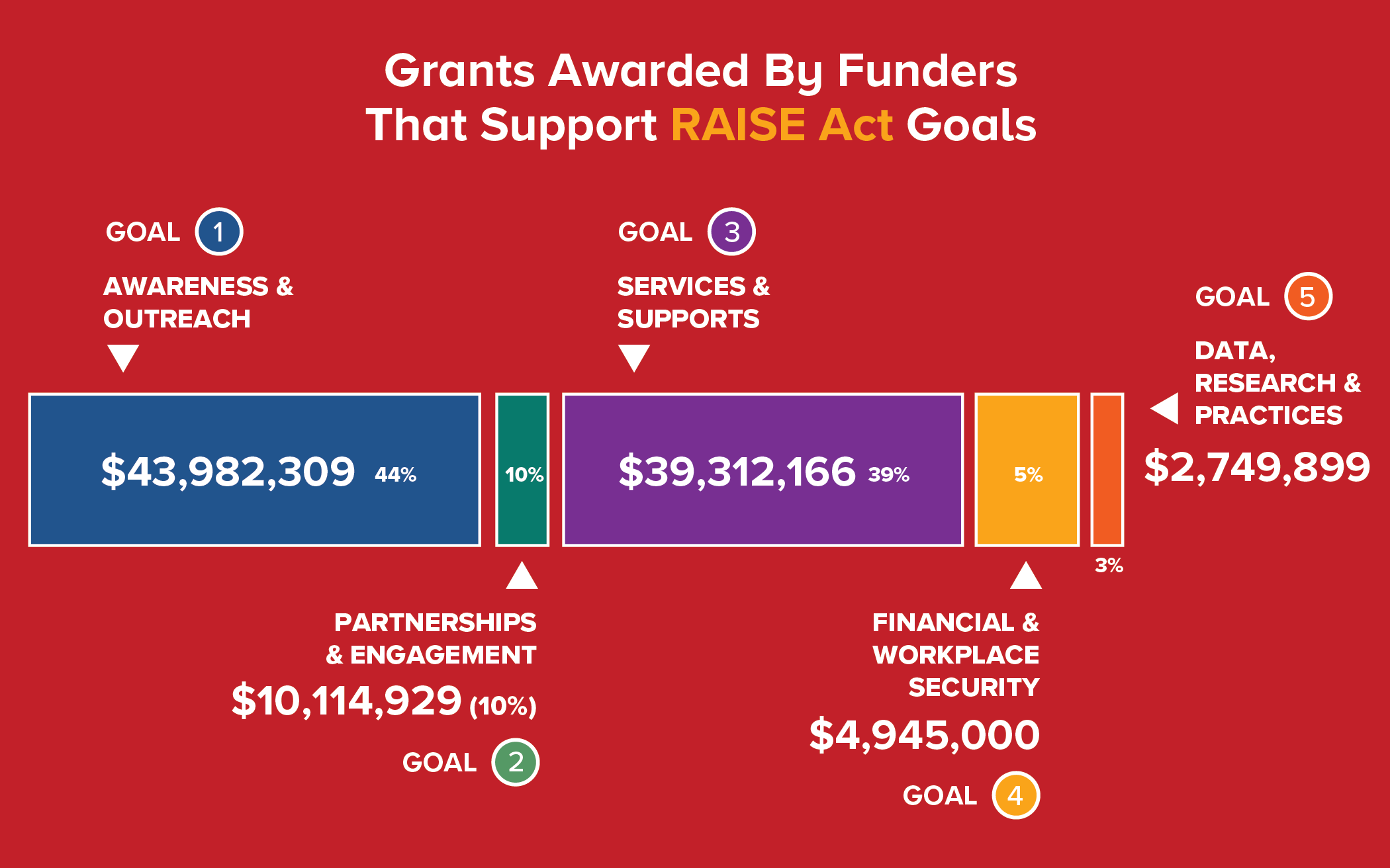
Family caregiving funders associated with Grantmakers In Aging awarded $100 million (370 grants) in 2021 and 2022 to community organizations that directly align with one of the National Strategy’s goals.
“We now track on an annual basis where funders are investing across the five goals of the National Strategy to identify gaps and opportunities for philanthropy to advance the recommendations.”
Emily Hinsey, Grantmakers in Aging
“The National Strategy serves as a foundational piece for when we apply for funding and helps guide implementation of our initiatives.”
Deborah Stone-Walls, USAging, RAISE Council member
“The National Strategy gave MLTSS plans new ideas for how they could support family caregivers and how they could partner with others to do this work.”
Mary Kaschak, Long Term Quality Alliance and National MLTSS Plan Association
STATE PROGRESS
States are making advances in respite policy, cross-agency collaboration on caregiver supports, and working with governors’ offices and legislators.
States indicate long-term commitments to supporting caregivers by aligning their state plans on aging with the National Strategy. States have developed new caregiver assessments, surveys, and caregiver training and have expanded access to respite programs.
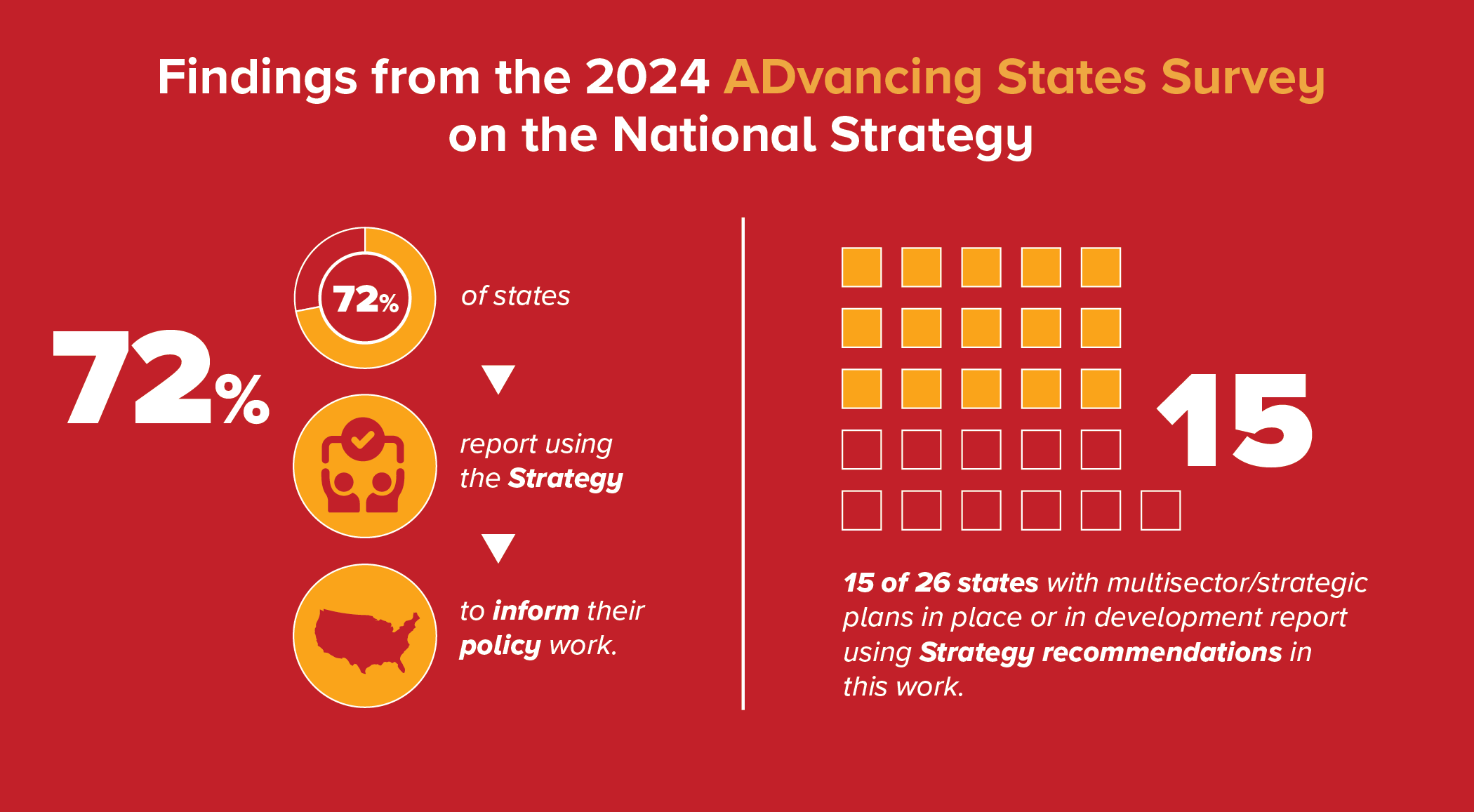
In early 2024, ADvancing States included questions on the impact of the National Strategy in its annual survey of state caregiving policies. Results from interviews with 42 states reveal:
A majority of states (72%) report using the Strategy to inform their policy work.
15 of 26 states with multisector/strategic plans in place or in development report using Strategy recommendations in this work.
States report using the National Strategy in a variety of ways, ranging from furthering working with governors’ offices and legislators to promoting cross-agency collaboration and engaging communities of interest.
State Lifespan Respite Care Grantees
State Lifespan Respite Care Grantees, who administer the Lifespan Respite Care Grant Program funded by the Administration for Community Living, are supporting the implementation of many respite actions outlined in the National Strategy:
Arkansas has created an initiative to distribute quarterly $300 Caregiver Respite Vouchers to caregivers for a total of $1,200/year. Since November 2022, the state has given 350 vouchers to over 182 caregivers.
In Delaware, the Division of Services for Aging and Adults with Physical Disabilities launched the “Are you a caregiver campaign,” a marketing strategy to assist caregivers to self-identify as caregivers.
The Montana Department of Public Health and Human Services partnered with Montana State University to launch a Caregiver Respite Food Program to provide HelloFresh or Blue Apron meals to unpaid family caregivers. In the first 30 days of the program, over 420 adults and 74 children in 28 counties and Tribal communities participated in the program.
The North Dakota Lifespan Respite program developed public service announcements for a Native Elder Caregiver Curriculum through Tribal radio stations (watch the first presentation in 2022, Bring, Brag and Borrow).
The Virginia Lifespan Respite Voucher Program will now provide up to $595 in reimbursement to grandfamilies and kinship caregivers for the cost of child care or recreational camps so they can take time to rest and recharge.
In Wisconsin, the WI Family and Caregiver Support Alliance introduced a Human Resources Care Kit to educate employers about family caregiver needs.
“We wanted to emulate [the National Strategy] at the state level and really see how our Area Agencies on Aging and Caregiver Resource Centers can both reach their optimal potential and ensure that they’re reaching deep into communities.”
Susan DeMarois, California Department of Aging
“The National Strategy helped to spur new state actions such as encouraging employers to offer respite information to working caregivers, training more respite providers, and connecting family caregivers to their preferred respite options.”
Jill Kagan, ARCH National Respite Network and Resource Center
National Momentum
The National Strategy has heightened awareness about the importance of caregiving across the country.
Historically, the important rolecaregivers play in our health care system has often been overlooked, but the COVID-19 pandemic brought their contributions into sharper focus. Interest is increasing at both the state and federal levels to acknowledge the value family caregivers play in supporting many older Americans and individuals with disabilities.
“The strategy provided a unifying structure for the work … a way for us to connect the dots and bring it all together.”
Susan Reinhard, Former Senior Vice President and Director of the AARP Public Policy Institute
One month of paid advertisement to promote a NASHP video about the National Strategy generated 1.5 million total impressions and over 500,000 video views.
The Act on RAISE Campaign, a campaign for Action on the National Strategy to Support Family Caregivers, was launched by the National Alliance for Caregiving, a coalition of national organizations dedicated to improving the lives of caregivers.
Eligible practitioners can now bill Medicare for providing training and education to caregivers of patients with chronic illnesses or disabilities thanks to new billing codes for caregiver training services.
USAging, the national association representing Area Agencies on Aging (AAAs), identified the National Strategy as one of its highest priorities for 2024.
According to a recent USAging survey of AAAs, 468 of 616 (76 percent) of Area Agencies on Aging have a caregiver program coordinator/manager on staff, and 67 (11 percent) would like to add one in the next three years; 209 (34 percent) have a caregiver trainer on staff, and 67 (11 percent) would like to add one in the next three years.
The ARCH National Respite Network dedicated its 2024 conference to elevating respite strategies in the National Strategy.
Grantmakers In Aging (GIA) credits the National Strategy with providing a framework to better track how funders are supporting caregivers in their funding geographies.
“The inclusion of youth caregivers in RAISE and the new National Strategy reflects a new era of federal, formalized recognition for people under the age of 18 as well as our current moment in the caregiving crisis.”
Caregiving Youth and the Patchwork History of Recognitionin the United States. Int J Environ Res Public Health. October 2023.
“The National Strategy provides a roadmap for implementation at the federal, state, and local levels to deliver meaningful and long-overdue support to family caregivers of all backgrounds and all walks of life.”
Didier Trinh, Diverse Elders Coalition
“The National Strategy created a platform for a baseline level of understanding for people in the caregiving field; it’s too early to tell what the impact has been on research, but it’s a promising start.”
Jennifer Wolff, Johns Hopkins University, RAISE Council Member
“The National Strategy has helped foster stronger relationships between direct care workers and family caregivers.”
Amy Robins, PHI
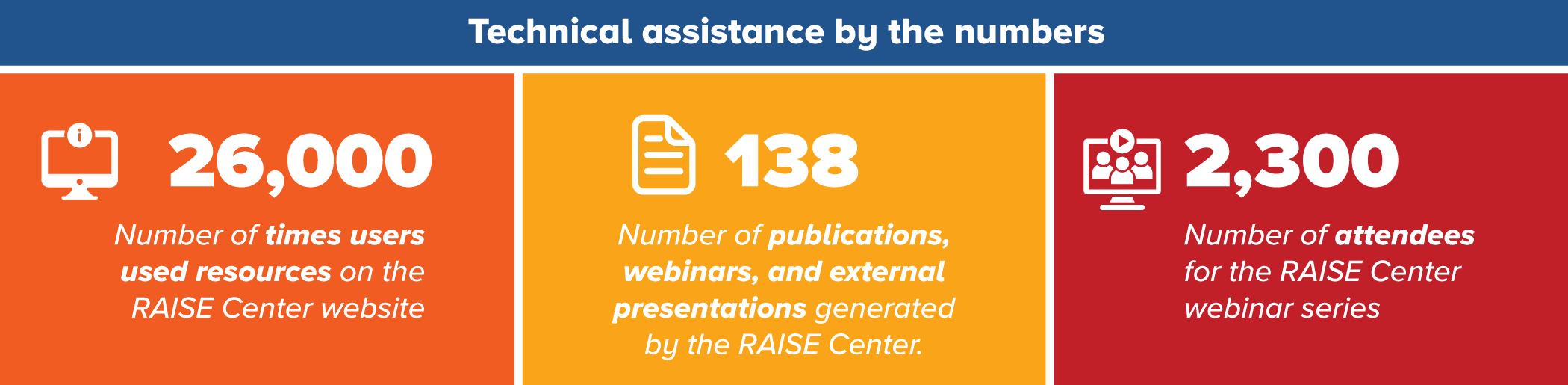
The RAISE Act Family Caregiver Implementation and Technical Assistance Center
Six states participated in NASHP’s Institute on Family Caregiving, resulting in expanded use of family caregiver assessments to assess caregivers for their own needs across the states of Connecticut, Illinois, and New York.
Sign up for NASHP’s RAISE newsletter for state and partner updates on implementation of the National Strategy.
Grandfamilies and Kinship Support Network
The Grandfamilies & Kinship Support Network, which launched in September 2021, is the first-ever national technical assistance center created for those who serve grandfamilies and kinship families. The network is funded by a five-year cooperative agreement with the Administration for Community Living. Since the release of the National Strategy, the network has:
Responded to over 730 individual requests for assistance, ranging from resource sharing to ongoing, in-depth assistance provided by subject matter experts.
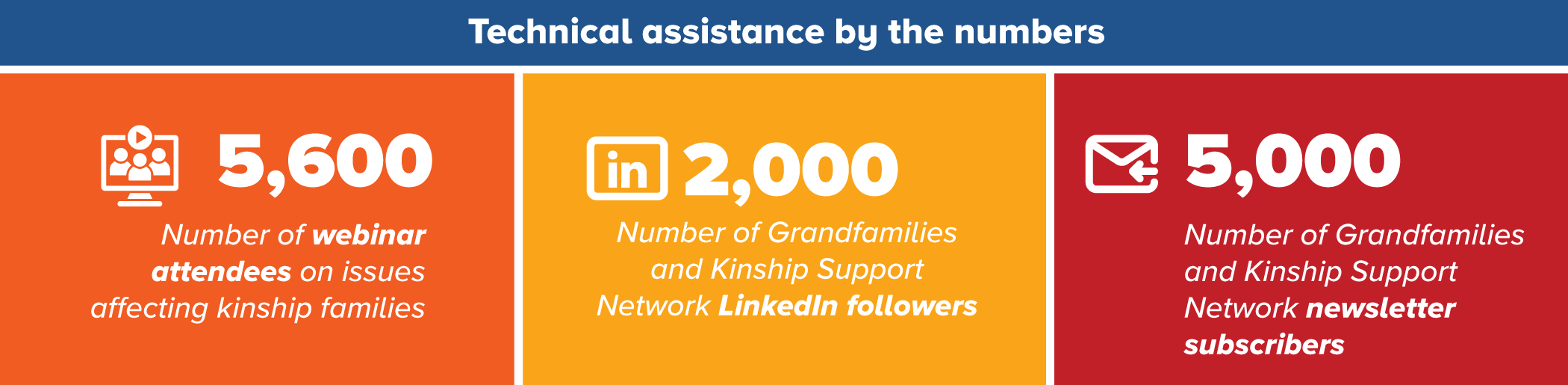
Reached over 5,600 attendees through 20 webinars that cover a range of issues that affect kinship families, such as affordable housing, child welfare, unaccompanied immigrant children in kinship families, and legal options.
Connected with over 2,000 followers on LinkedIn and sent a monthly newsletter to over 5,000 people.
“The hands-on, step-by-step technical assistance from the Grandfamilies & Kinship Support was instrumental in getting our new Grandparents Raising Grandkids Resource Center running in Central Massachusetts.”
Moses Dixon, President & CEO, Central Massachusetts Agency on Aging
Notable Publications
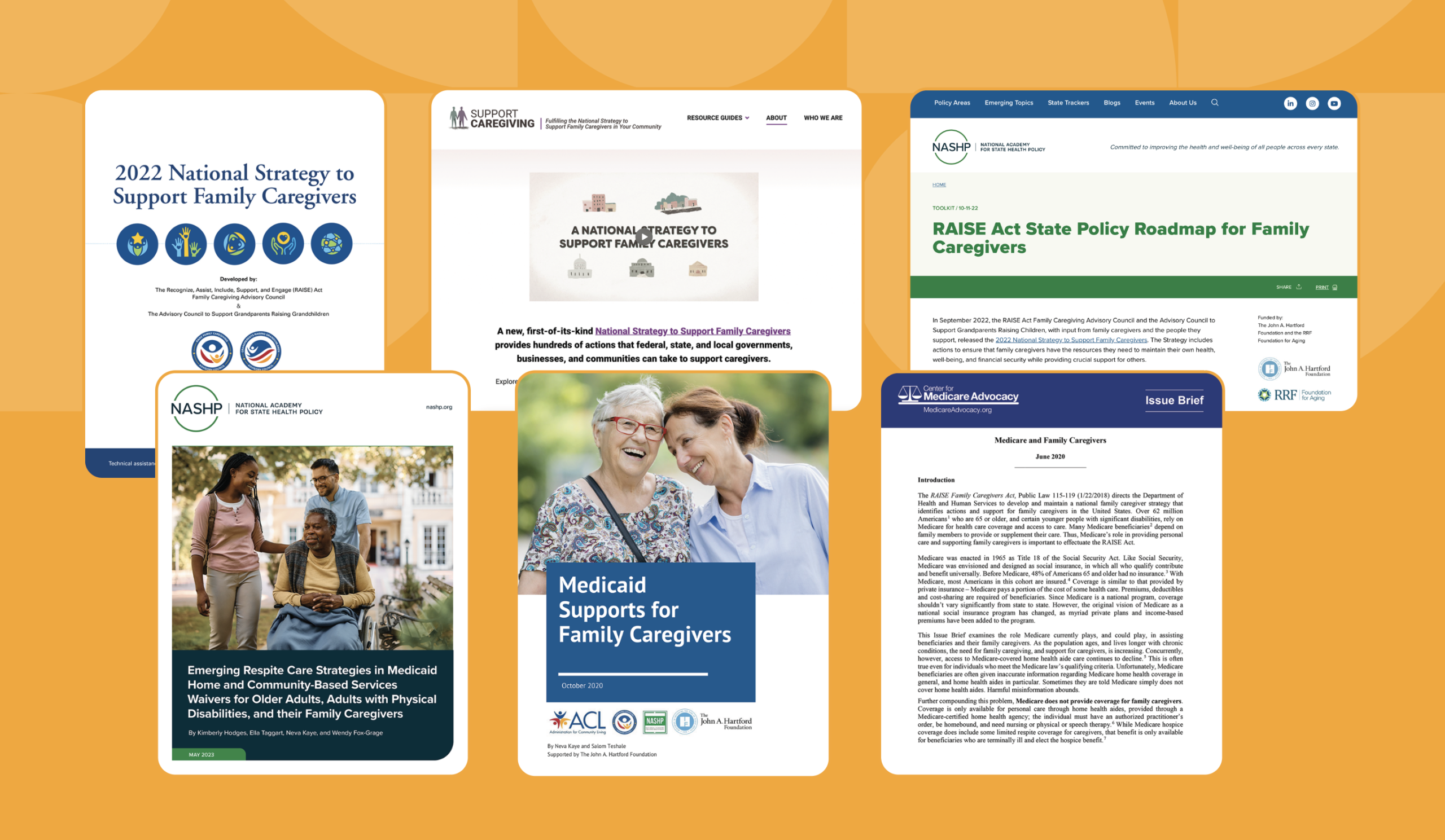
2022 National Strategy to Support Family Caregivers. The National Strategy identifies 350 actions the federal government can take to support family caregivers and more than 150 actions that can be adopted by states, local governments, and the private sector to build a system to support family caregivers.
SupportCaregiving.org features 12 resource guides written by leading national organizations to help employers, families, managed care plans, state officials, counties, and others implement the National Strategy. Since its creation, SupportCaregiving.org has had 16,000+ page views.
RAISE Act State Policy Roadmap for Family Caregivers features state policies and promising practices on the direct care workforce, awareness and outreach to family caregivers, engagement with the health care system, services and supports, financial and workplace security, and research and evidence-based practices to support family caregivers.
Medicaid Supports for Family Caregivers (by NASHP) features strategies that states can take to support family caregivers within the Medicaid program, state examples of family caregiver supports, and actions for federal consideration.
Administration for Community Living, U.S. Department of Health and Human Services
American Association of Caregiving Youth
ARCH National Respite Network and Resource Center
Caring Across Generations
Community Catalyst
Daughterhood
Diverse Elders Coalition
Drexel University
Eldercare Workforce Alliance
Family Caregiver Alliance
Generations United
Grandfamilies & Kinship Support Network
Grandparents Raising Grandchildren Advisory Council
Grantmakers in Aging
Institute for Healthcare Improvement
Johns Hopkins University
LeadingAge LTSS Center @UMass Boston
Long-Term Quality Alliance
National Alliance for Caregiving
National Association of Counties
National MLTSS Health Plan Association
PHI
RAISE Family Caregiving Advisory Council
Ralph C. Wilson, Jr. Foundation
Rosalyn Carter Institute
Rush University Medical Center
Society for Human Resource Management
The John A. Hartford Foundation
University of California, Los Angeles
USAging
“Like most people, I didn’t think about caregiving until my father was diagnosed with cancer. That was a wake-up call for me, certainly — one that really opened my eyes to the world of caregiving.”
Caregiving, a two-hour documentary from WETA, co-executive produced by Bradley Cooper (a caregiver for his father) and his production company, Lea Pictures, will premiere in Spring 2025 with support from corporate, non-profit, and philanthropic sponsors and partners.
Caregiving can be one of the most rewarding but biggest stressors a person can face. Caregiving can take a toll on an individual’s health and well-being, relationships, and financial security. Progress is happening, and you can keep this momentum growing by supporting family caregivers as a national priority.