

States recognize the importance of a comprehensive understanding of their behavioral health workforce to address shortages and maldistribution, including identifying workforce skills, practice locations, licenses and credentials, populations served, and opportunities for strategic growth to meet demand. This information can inform workforce development and sustainability policies by highlighting components most in need of targeted interventions. However, needed information is often spread across multiple entities — licensure agencies, professional associations, and providers — making it challenging to develop a comprehensive workforce picture.
Utah’s Office of Professional Licensure Review (OPLR) approach offers a model for states seeking to develop a structured behavioral health workforce landscape and data analysis strategy to inform policy decisions and rapid application of those findings. The office’s systematic review of behavioral health workforce regulations led to the enactment of SB 26 in 2024, which introduced significant workforce enhancements.
Key steps Utah used to strengthen workforce analysis and translate findings into policy actions include:
- Using a conceptual frame clearly defining “access to care” needs to guide data analysis and interpretation
- Identifying relevant data sources, gathering and synthesizing data, and contextualizing interpretation with input from multiple key players
- Directly cross-walking access gaps with specific workforce data and policy options (establishing a consistent timeframe for comparison)
- Telling the story: linking data to recommendations for legislative and executive branches with context from real–life experiences of people who need or provide services
Utah’s Approach
In response to Executive Order 2021-01, and codified in SB 16, the OPLR, in the Department of Commerce, systematically analyzes workforce licensing statutes and regulations for executive branch agencies and legislator consideration. As part of this mandate, OPLR ensures that administrative rules and processes align with the needs of state residents and licensees, while reducing unnecessary administrative burdens.
OPLR reviews all proposals for new occupational regulation (licensing, certification, registration) in the state, as well as the regulation of each currently regulated occupation at least once every 10 years. By statute, OPLR considers three factors when evaluating the need for licensure:
- Public safety and potential harm (including financial)
- Access to services and workforce entry
- Health care reimbursement where applicable
A core part of OPLR’s analysis methods (described in detail below), and those of the department as a whole, includes gathering direct input from people providing and receiving services and their families, which ensures regulatory decisions reflect on-the-ground needs.
As part of its 10-year review of the behavioral health field, OPLR conducted an in-depth analysis of workforce trends and needs. The resulting findings and recommendations directly informed the state’s 2024 legislative activity, during which SB 26 was enacted. The law includes a variety of workforce enhancements, including:
- Creation of the Behavioral Health Board (a multi-professional board to replace some individual licensing boards)
- Streamlined supervision requirements
- Building an alternative pathway to certain licensures through increased direct client care hours and supervised clinical hours, in lieu of examination requirements
- Initiation of several new behavioral health licensure types, including behavioral health technician and behavioral health coach
- Expansion of the scope of practice of social service workers and advanced substance use disorder counselors to include reviewing and updating treatment plans and providing therapy under supervision of a mental health therapist
Utah’s Data Analysis Methodology — Considerations for Workforce Data Analysis
The Utah OPLR used the following methodology to analyze its behavioral health workforce needs.
Primary Data Collection and Engaged Partner Input — To develop a thorough understanding of the varying perspectives of the state’s behavioral health system components, OPLR conducted a survey of the behavioral health workforce, along with focus groups, interviews, and informal meetings and discussions with approximately 4,000 respondents.
Secondary Data Analyses — To better understand the prevalence of behavioral health conditions in Utah and to assess consumers’ access to safe and competent care, OPLR analyzed national- and state-level data on behavioral health disorder prevalence.
Policy Landscape and Academic Literature Reviews — To inform regulatory options, OPLR reviewed regulations across the states alongside an in-depth review of academic and policy literature.
Utah applied a multi-pronged data collection approach to capture state residents’ need for behavioral health care, the gaps in receiving needed services, the professions that make up the behavioral health workforce, factors that affect access to care, and the contextual factors provided by a broad range of invested groups, including licensees, employers, associations, and advocates for those receiving services (see call out box).
Utah’s Data Analysis Methodology — Considerations for Workforce Data Analysis
Utah defines “access to care” as whether individuals can receive the care they need when they need it. The concept can be understood and measured in terms of Utah’s “Six A’s” — whether services are available, affordable, accessible, acceptable, and adequate, and whether patients are aware of the services and options available to them. This framing guides OPLR’s methodology, interpretation, and resulting recommendations.
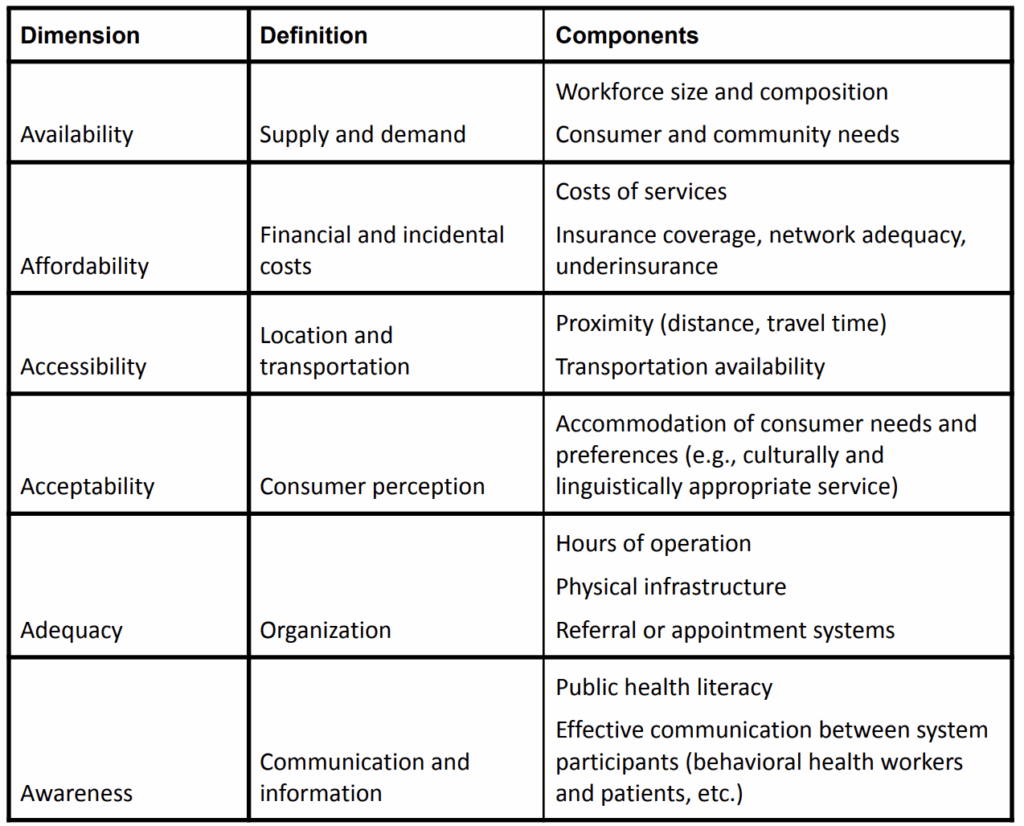
Penchansky R, Thomas JW. The Concept of Access: Definition and Relationship to Consumer Satisfaction. Medical Care. 1981;19(2):127–40.
Defining Need & Gaps
Understanding Demand
Using the Six As frame, Utah cross-walked data on unmet behavioral health needs with quantified workforce gaps and pipeline issues to provide a clearer picture for targeted improvements. OPLR used data from the National Survey of Children’s Health (NSCH) as well as the National Survey on Drug Use and Health (NSDUH) to determine current demand and estimates of the proportion receiving care (OPLR report p. 24).
According to the analysis, Utah’s behavioral health care system is serving the needs of approximately 527,000 people, with an estimated 39% to 98% of additional people with perceived or clinically defined unmet need for care.
Understanding Workforce Gaps
Among other findings, the Periodic Review of Behavioral Health Field Level Report uncovered a need for behavioral health workforce “extenders,” which the report defined as workers who “are most often educated at the undergraduate, associate, or certificate level, rather than at the graduate degree level. They typically provide care to patients while under the direct or general supervision of more advanced practitioners.”
Notably, compared to the physical health field, where extenders account for approximately 67% of the licensed professionals in Utah, extenders only account for around 27% of the licensed behavioral health professionals. To address even the lower unmet need for care would require at least an estimated 2,500 additional extenders (see Figure 1).
Figure 1
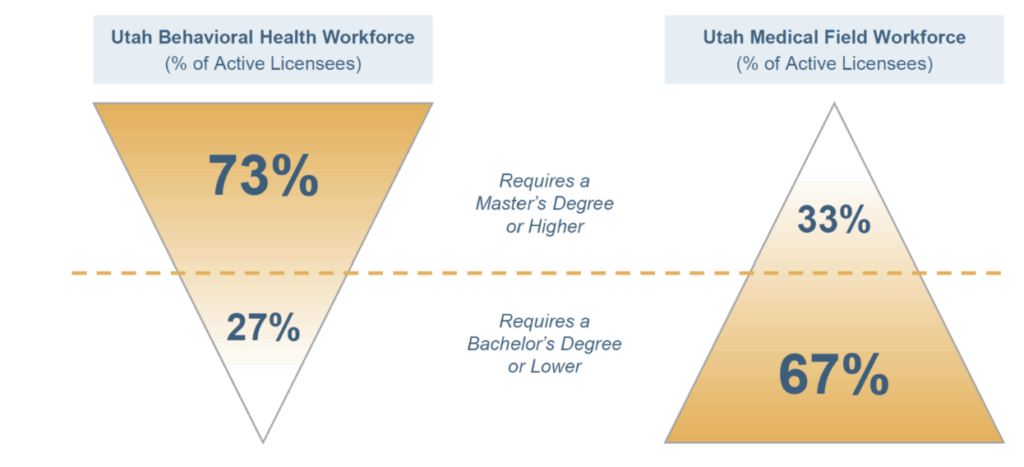
Source: DOPL licensee data obtained from DOPL MLO report “Active License Count,” accessed 2/28/2023; data on DHHS licensees provided to OPLR by DHHS administrators in July, 2022. The figures presented do not reflect members of the workforce who hold a private certification (e.g., CNAs) or no certification (e.g., psych techs).
Analyses also identified misalignment between education, licensure, and workforce demands, ultimately recommending the development of new behavioral health licensure types to bridge the gap between degrees earned in the state (such as a bachelor’s level degree in Psychology) and the need for behavioral health workforce (figure 2).
Figure 2
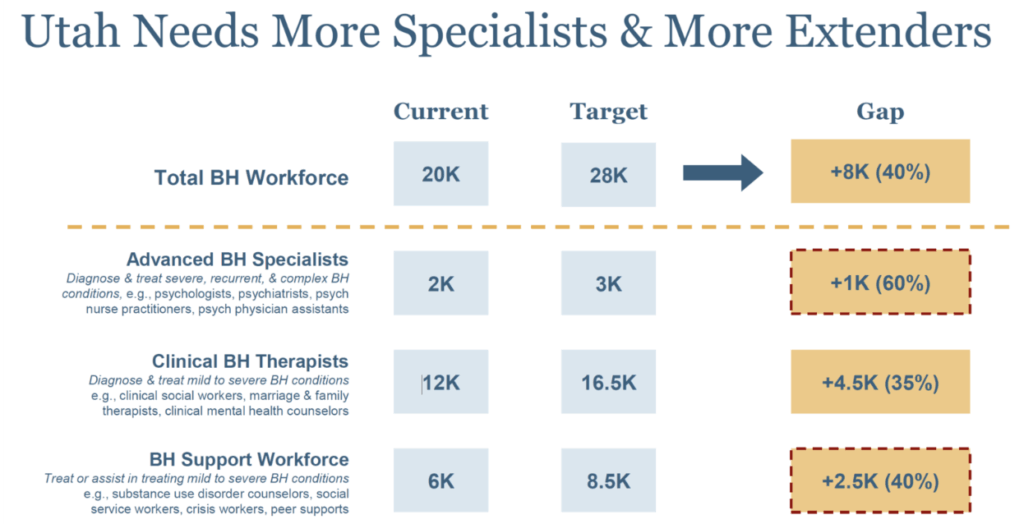
Values rounded to nearest 5% or to nearest 500. Target uses IAPT guideline of 10% advanced, 60% clinical, & 30% support. Workforce figures based on DOPL MLO report “Active License Count,” accessed 2/28/2023; data on DHHS licensees provided to OPLR by DHHS administrators in July, 2022; data on advanced BH specialists from University of Michigan, Behavioral Health Workforce Research Center, 2018 – Mapping Supply of the U.S. Psychiatric Workforce; Unmet need figures based on 2020-2021 National Survey of Children’s Health; 2018-2019 National Survey on Drug Use and Health.
In the state, psychology undergraduates are eligible for behavioral health credentials, but only with additional coursework — like any other undergraduate. In other words, a psychology undergraduate major provides students with no advantage in terms of licensure for any behavioral health license in Utah. However, a Bachelors in Social Work corresponds directly to the Social Service Worker license (see figure 3).
Figure 3
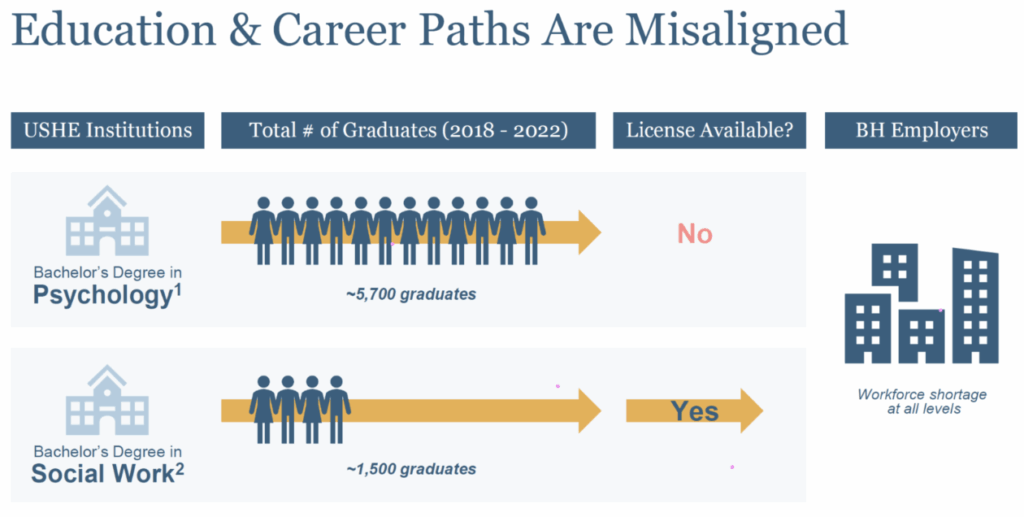
Source: Utah System of Higher Education IPEDS Completions Survey; Graduates from 5 year span of 2017-2018 to 2021-2022 academic years.
Licensee Surveys and Focus Groups
OPLR officials combined survey data with information collected through a variety of stakeholder input mechanisms to inform workforce gaps and potential solutions, including:
- Behavioral Health Care Workforce Survey: OPLR distributed a survey to all active DOPL BH licensees to collect workforce data such as licensees’ employment status, setting, education, geographic distribution, and demographics.
- Listening & Vetting Tour: OPLR conducted twelve industry focus groups and over one hundred interviews with practitioners, DOPL board chairs, DHHS administrators, and a wide variety of other experts, leaders, and groups in both BH care and licensing policy. Of note, Utah officials included a survey question that invited further engagement from which they developed a random sample for focus groups.
After developing initial recommendations, OPLR presented its findings and draft recommendations to over two hundred interested parties for feedback. This feedback informed revision and helped officials refine the specifics of the final recommendations.
Defining the Scope of Behavioral Health Professions
Every state’s behavioral health workforce landscape varies, so identifying the specific professions and credentials for inclusion in analysis is critical. Licensure and credentialling information may be held with licensing agencies, health and human service agencies, nursing boards, or medical boards; therefore, developing relationships and data sharing agreements with those licensing agencies may be necessary to gather a full picture of the workforce. Here is a broad array of professions from which states may draw for similar analyses:
Behavioral Health Professions to Consider
This list is not exhaustive and may not reflect the behavioral health landscape of every state. For the professions that Utah included, see page 14 of the report.
Art, Movement, and Music Therapist
Behavior Analyst
Certified Addiction Medicine Specialist
Certified Family Caregiver
Certified Peer Support Specialist
Certified Youth Peer Specialists
Certified Recovery Coaches/Mentors
Child/Family Peer Support Specialist
Clinical Mental Health Counselor
Community Health Workers
Family Resource Facilitator
Licensed Chemical Dependency Counselor
Marriage & Family Therapist
Psychiatric-Mental Health Advanced Practice Nurse
Psychiatrist
Psychologist
Social Worker
Substance Use Disorder Counselor
Traditional Health Workers (i.e., doulas, tribal healers)
Therapeutic Recreation Specialist
Vocational Rehabilitation Counselor
Other state-certified positions, like Certified Case Manager, Certified Crisis Worker, or Behavioral Health Technician
Other Resources for Consideration
Most states do not have a single agency that has access to all the necessary data or expertise for a full picture of the behavioral health workforce landscape. Interested state officials may need to partner with a variety of organizations to gather relevant data. For example, licensing agencies or professional and provider associations can provide routes to survey behavioral health workers directly to gain an understanding of important components of the behavioral health workforce landscape beyond a headcount of practitioners. These groups can directly survey licensees and members about whether they accept Medicaid clients, if they practice via telehealth in other states, or if they specialize in specific populations such as children or marginalized communities. In Texas, the Behavioral Health Executive Council, an umbrella licensing agency for four behavioral health professions, surveys its licensees and partners with the University of Texas to analyze the results.
Some state agencies may not have experts in evaluation or data analysis, so partnerships with universities can supplement existing efforts to develop actionable, understandable analyses. For example, the Behavioral Health Education Center of Nebraska, created through a revised statute, provides the state a set of experts who research and collect data to understand the state’s behavioral health workforce.
The Health Resources and Services Administration publishes national data on various components of the health workforce, including the behavioral health workforce, in its National Center for Health Workforce Analysis. The tool projects health care workforce supply and demand at both the state and national level, allows for trends by discipline, and offers hypothetical scenarios that consider changes in the health care context.
Acknowledgments
The author thanks Jeff Shumway and the staff at the Utah Department of Commerce’s Office of Professional Licensure Review for their contributions. This publication was supported by the Health Resources and Services Administration (HRSA) of the U.S. Department of Health and Human Services (HHS) under grant number U2MOA39467 the National Organizations of State and Local Officials co-operative agreement. This information or content and conclusions are those of the authors and should not be construed as the official position or policy of, nor should any endorsements be inferred by HRSA, HHS, or the U.S. government.