
Committed to improving the health and well-being of all people across every state.

Academy Spotlight with David Seltz: Driving Change in Massachusetts Health Care

This series is part of a spotlight on members of NASHP’s Academy, showcasing the expertise and leadership they bring to advancing state health policy. Each feature offers a closer look at their work and the meaningful contributions they make to NASHP’s mission.

David Seltz, Executive Director of the Massachusetts Health Policy Commission and a leader in NASHP’s Academy, brings deep insight into state-level health care innovation. In this Q&A, he reflects on how early experiences in the Massachusetts legislature shaped his career, the power of collaboration and peer learning, and what continues to inspire him in public service. 

What was your entry point into health policy?

I worked for the Senate Ways and Means Committee in the Massachusetts state legislature, which helps prepare the annual budget. And, in my role, really, fresh out of college, I was assigned the health care accounts, and that meant you had to become the staff expert on all of the different accounts that help fund and finance the Medicaid program in Massachusetts. To be thrown in the deep end, trying to understand the very complex financing mechanisms and programs that the state had to provide coverage and benefits to its residents was just a tremendous learning opportunity. 

Ultimately, I fell in love with state health policy because it’s so complex, and there are so many challenges. But there is space to innovate, and especially at a state level, an ability to experiment and to try new things, and that all has a real, tangible impact on people. 

What’s one initiative or moment that made you feel especially proud in your line of work? 

In Massachusetts, I worked on a reform effort to achieve universal health insurance coverage. We were the first state to accept this as our goal. We were successful, and ultimately, Massachusetts became the model for the U.S. Affordable Care Act.  

How did Massachusetts’ focus on health care affordability lead to the creation of the Health Policy Commission? 

As a state, we recognized that we needed to make sure that health care was affordable. And the rising costs of health care were increasingly making that not only unaffordable for government, but unaffordable for businesses, families, and individuals. So, in Massachusetts, we decided to make another big reform effort that really focused on health care cost containment and affordability. And as part of that, set up a new independent state agency called the Health Policy Commission, and that’s where I’ve been for the past 13 years. 

You’ve held leadership roles across different parts of the Massachusetts state government. How has your perspective on policy implementation evolved over time? 

One is the importance of data and information that is viewed as objective and that has integrity. Many different stakeholders will make arguments about where the cost drivers are and who’s to blame, so having objective data and information is a foundational step for policy implementation.  

Another aspect is the importance of relationships, and just being curious and humble and allowing people to be able to call you and tell you what they think. To be able to have an honest exchange of ideas with industry stakeholders, with legislators, and with policymakers is important to continue the trust that is essential to health policymaking. 

What’s something about working in state government that you think is often misunderstood or underappreciated? 

When I first started my career in state health policy, I would tell my friends I worked for a state senator, and some (not in government) wouldn’t even know what state government was. There was so much focus on the U.S. Senate and DC. I thought, I’ve got to get to DC — it’s the center of the universe for policymaking. And it is for many things, but with state health policy, there’s an incredible opportunity to innovate and experiment. You can work on a law, pass it, start implementing it within a year, and a few years in, tweak it based on data and experience. Being flexible, nimble, and able to evolve makes state government so exciting to work in. 

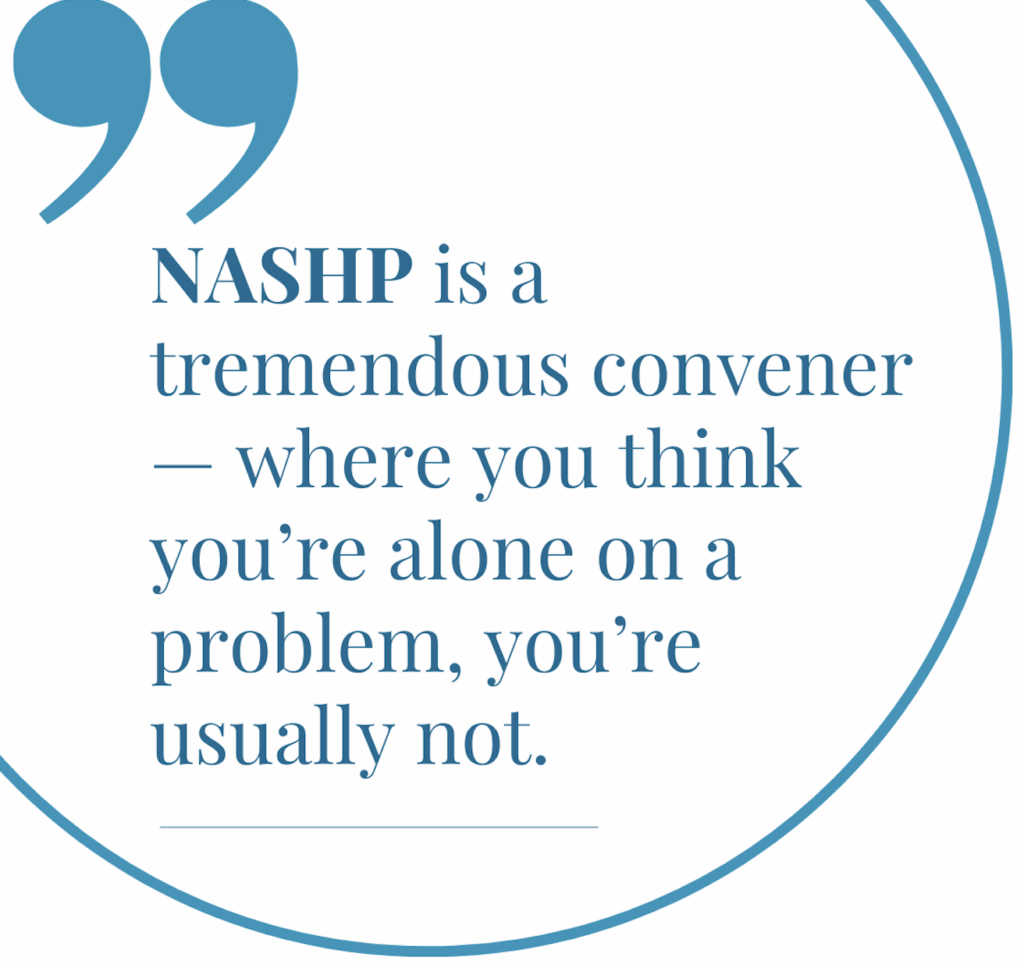
I also really appreciate the ability to learn from 49 other states. NASHP is a tremendous convener — where you think you’re alone on a problem, you’re usually not. Someone else is struggling with the same concept, implementation, or data analysis. NASHP helps make those connections; it’s like the journal of science for state policy, helping us share results and lessons learned. 

The NASHP Academy is all about peer learning and connection. What’s a lesson or insight you’ve taken away from a fellow Academy member that really informed your work? 

Over the decade that I’ve been an Academy member, I’ve benefited so much personally and professionally, and health policy in Massachusetts has benefited so much from this relationship. When we were first starting our efforts around health care cost containment, we were really the leading state. No other state had tried to do what we were doing in terms of really trying to bend the health care cost curve and moderate health care spending growth. We had a really novel policy innovation at the time: a health care cost growth benchmark, or a measurable target for annual growth in health care spending. And there was no playbook for us, in terms of actually implementing that. 

In those early days, what I so tremendously appreciated from NASHP and from the other Academy members was just being able to talk to them about how they do problem-solving, how they engage with stakeholders. 

Later, in a few more years, more states started to do some of the same types of policy work that we were doing. And many of those states have now gone further than what we’re doing. Now, I’m learning from other Academy members about where they have gone and implemented ideas that we haven’t yet been able to implement. It’s been an interesting arc of learning in different aspects and different phases. 

As we’re talking today – we’re just a few weeks from NASHP’s annual conference, so it’s top of mind for us! I wondered if you could talk about NASHP’s conference. What keeps you coming back? Are there particular moments or experiences that stand out for you? 

NASHP’s conference is my favorite that I go to, by far. It is, without a doubt, the number one best health policy conference there is in the country, if not the world. The things that I most appreciate are the opportunity to engage with my colleagues in person. To be able to network in between some of the sessions, and to grab someone, even for a couple of minutes, and ask a few questions, check in on how they’re doing, what’s happening within their state, and just continuing to nurture that network of relationships.  

This is a particularly hard time working in state government. Having this opportunity for community is really important. It’s great to know that you’re not alone; we’re all in this together, we’re all going to try to think through ideas on how to manage some of these big challenges and support each other. 

What’s one piece of advice you’d give to the next generation of policy leaders? 

Especially in this environment, there is a need for both patience and persistence. Sometimes there is a need to work at something for a while, and to build the case for change to happen, and to have that patience to know that even if it doesn’t happen in the first year or the second year, that you can be working towards that impactful change that you want to see happen, and having that persistence to keep at it. 

My other advice for young people coming up is to build that network and build your trusted relationships. They will nurture you and support you in your career, and that is a tremendous asset to have.  

RELATED CONTENT

Search

Sign Up for Our Weekly Newsletter

* indicates required
Please enter a valid email address.
Areas of Interest