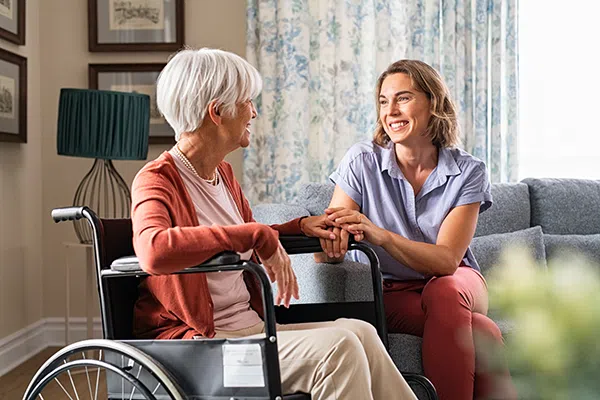

One of the essential principles of the 2022 National Strategy to Support Family Caregivers is to support family caregivers in cultivating needed connections in and out of the health care and long-term care systems. This principle is rooted in whole-person care and the recognition that navigating the deeply siloed and complex array of health, social services, and community supports is daunting — especially in chronically underserved communities. An emerging, but not fully realized, trend in the aging and chronic disease space is to link patients and their caregivers with community health workers (CHWs) to navigate these complex systems.
“Ensuring family caregivers have the resources they need to continue to support older adults and disabled people in the community is critical to containing the rising costs of health care.”
CHWs are trusted members of the communities they serve and are uniquely suited to meet the needs of family caregivers by offering culturally and linguistically appropriate connections to care, community resources, supports, and services. States are systematically advancing partnerships with CHWs to build CHW capacity and pay for CHW services across a variety of domains given the critical role they play in connection with communities and underserved individuals who experience health disparities.
Opportunities for CHWs to support older adults are also emerging at regional and local levels. For example, nationally, 21 percent of Area Agencies on Aging (AAAs) currently have a CHW on staff, and 20 percent report needing to add or hire additional CHWs in the next three years. Within these efforts, there is an opportunity to grow CHW support for family caregivers.
Below are examples of state approaches in this emerging policy space.
For more information about state approaches to support CHWs, check out NASHP’s resources:
- 50-State Tracker: State Community Health Worker Policies
- State Trends: Trends in State Policies that Support the Community Health Worker Workforce
- Medicaid Reimbursement: State Approaches to Community Health Worker Financing through Medicaid State Plan Amendments and Updates and FAQs: Developing and Implementing a Medicaid State Plan Amendment to Authorize Community Health Worker Reimbursement
- Partnerships: Lessons for Advancing and Sustaining State Community Health Worker Partnerships
Wisconsin
During the onset of the COVID-19 pandemic, the Wisconsin Bureau of Aging and Disability Resources leveraged Centers for Disease Control and Prevention (CDC) health disparities grant funding to hire CHWs to supplement support for older adults living in home- and community-based settings. Three of the state’s 51 aging and disability resource centers (ADRCs) used CDC-piloted CHW programs. Each program used different approaches, largely focused on hiring trusted messengers to better reach refugee, rural, and impoverished communities. CHWs also conducted memory screenings, taught classes on brain health, and delivered meals to older adults living alone. ADRCs have reported overall success from these pilot programs and are interested in using state-funded grants to support CHWs as an optional service.
The dementia care specialist program, which is embedded across ADRCs and each of the state’s 11 federally recognized Tribes, supports those with dementia, along with their caregivers. While CHWs are not directly employed in this program currently, program administrators note they could help establish rapport and build trust with caregivers in communities that have been more difficult to reach. CHWs could offer community-specific problem-solving and help build connections with pillars of community, such as police officers, restaurants, and public facilities, to educate and advocate for support and accommodations for persons with dementia.
California
The California Department of Aging CAlz Connect Program, funded by the Administration for Community Living (ACL), provides support for those living with dementia, along with their caregivers. The program is piloted in three counties, embedded within ADRCs in AAAs in Imperial and Ventura counties and within the Center for Independent Living in Marin County. Using the evidence-based UCSF Care Ecosystem model, trained CHWs reach out by phone and email to people with dementia and their caregivers one or more times per month over a six-month period. The CHWs provide support, education, and resources on coping with stress, preventing injuries, staying healthy, and connecting to community services. Although the program is still in its early stages, preliminary findings indicate reductions of care burden for caregivers and increases in quality of life for people with dementia who have completed the program.
Training for CHWs
Many states are working with CHW partners to develop standards for CHW certification and training programs. These standards often include a core curriculum modeled after the competencies outlined in the National C3 Council. Training programs led by state and community-based organizations (CBO) provide core curricula that equip CHWs with cross-cutting skills to navigate multiple systems in support of families, as well as specialty tracks for CHWs across an array of disease-specific or population-specific needs. To address the unique needs of aging populations across the state, California has funded a series of programs through CalGrows, the California Department of Aging’s Direct Care Workforce Training and Stipends Program, for CHW trainings in older adult and caregivers supports as well as CHW-run support and education centers. Funded entities include the Alzheimer’s Association of Northern California, El Sol Neighborhood Educational Center, Partners in Care Foundation, San Diego State University Research Foundation, and Visión y Compromiso.
Recent investments in CHW training from the Health Resources and Services Administration (HRSA), the CDC, and ACL have been used to strengthen and expand the community-based public health workforce to improve community responses during and following the COVID-19 pandemic. In the examples below, states have received grant funding to support home- and community-based service systems for older adults. States could draw lessons from these models to scale and spread family caregiver supports. For example:
- The Latino Alzheimer’s and Memory Disorders Alliance (LAMDA), which receives HRSA and ACL funding through the Alzheimer’s Disease Program Initiative (ADPI), supports members of the Latino community living with Alzheimer’s and dementia and their caregivers. LAMDA provides both general and specialized dementia training for promotores in Chicago and partners with academic institutions and CBOs in New York City and San Francisco. LAMDA promotores conduct memory assessment screenings in Spanish and support caregivers by connecting them to resources to promote self-care and stress management and provide education about dementia in the Latino community.
- With support from ACL’s ADPI, Indiana University partnered with Indiana’s AAAs to implement the Caregiver Stress Prevention Bundle. CHWs employed by AAAs received dementia-specific care training to support caregivers through education, respite care, and connections with a support group.
- CICOA Aging and In-Home Solutions, a Central Indiana AAA, recently launched a CHW initiative through its Flourish Care Management service with a grant from Purdue University’s Center for Health Equity and Innovation that covered the cost of certification for an initial cohort of CHWs. Subsequent CHW cohorts have received certification with YMCA grant funding. The initiative has integrated CHWs into care management teams, where they work alongside certified providers to support care transitions for high-risk clients, particularly those with dual special needs. CHW integration has contributed to improvements in social determinants of health and quality-of-life outcomes for clients, increased timeliness in care coordination following hospitalizations, and reduced hospital readmissions. For example, three months after CHW interventions this year, the average number of client hospitalizations fell from 1.3 percent to 0.4 percent. CICOA also reports a 30.5 percent increase in clients who understand their medications, a 12.9 percent increase in clients who say they “never” felt worried, tense, or anxious in the past 30 days, and an 8.1 percent decrease in clients who report that they “sometimes, rarely, or never” have healthy food to eat.
- OCCK in Kansas uses ADPI funding to provide a community- and team-based support for people living with dementia and their caregivers using the Care Ecosystem Model. Cognitive care navigators provide care navigation support to both parties, with a focus on providing moral support, respite, and assistance connecting to other services and resources. CHWs could bring a community-specific, lived experience lens to these types of navigation services — extending the reach to underserved communities.
- With support from The John A. Hartford Foundation, the Institute for Healthcare Improvement, the University of Texas at Arlington, and the National Rural Health Association, the Texas Department of State Health Services (DSHS) offers continuing education credit for age-friendly health-system training provided to CHWs and promotores (CHW/Ps) virtually. The DSHS-certified training is administered by the Alzheimer’s Association of Dallas and Northeast Texas and is open to CHW/Ps across all regions of the state. The curriculum is available in both English and Spanish and is designed to provide a comprehensive understanding of Alzheimer’s disease and dementia, early detection strategies for both diseases, care and stress management strategies for caregivers, and support resources. To date, over 500 CHW/Ps have participated in the program.
For more information about CHW financing, certification, and training across states, see NASHP’s 50-state tracker.
Implications for State Approaches to Financing
As pandemic-era federal grant funding specific to CHW infrastructure expires, states are seeking supplemental funding opportunities to maintain and grow access to CHW services and supports. With a rapidly aging population, family caregiver supports will be a part of that service array. In addition to private investments, public funding — such as Medicaid reimbursement — is an important tool for increasing access to much-needed CHW services among Medicaid enrollees and in securing financial sustainability of the CHW workforce. Twenty-four states are leveraging Medicaid authorities (State Plan Amendments, 1115 demonstration waivers, and managed care approaches) to cover a wide range of CHW services.
Providers can take advantage of new opportunities to provide CHW services to Medicare beneficiaries, augmenting caregiver options. CMS authorized new billing codes in the 2024 physician fee schedule for Community Health Integration (CHI) and Principal Illness Navigation (PIN) services, which aim to more effectively integrate social supports with health care and explicitly encourage use of CHW services (as well as peer support specialists and patient navigators). As states respond to family caregiver needs to navigate community health, human services, and social supports for older adults, they may consider aligning insurance coverage policies with other funding sources (such as the Older Americans Act funds) to support the needed workforce.
Next Steps
There is a clear and growing need for family caregivers to connect to and navigate person- and family-centered supports such as health care, housing, and nutrition. The 2022 National Strategy to Support Family Caregivers deems such supports essential, with special consideration for advancing equitable access in traditionally underserved communities. Opportunities to work with CHWs serving family caregivers continue to develop across states. Some state and local models provide examples to support the systematic incorporation of CHW services to address clear gaps in reaching underserved populations. Current efforts are often grant-based, pointing to strategic consideration of sustainable financing approaches such as aligning Medicaid and Medicare approaches with dedicated federal and state dollars.
Acknowledgments
This paper was co-authored by Elinor Higgins, executive director of the Maine Permanent Commission on the Status of Women.
Support for this work was provided by the Robert Wood Johnson Foundation and The John A. Hartford Foundation. The views expressed here do not necessarily reflect the views of the foundations.