
This series is part of a spotlight on members of NASHP’s Academy, showcasing the expertise and leadership they bring to advancing state health policy. Each feature offers a closer look at their work and the meaningful contributions they make to NASHP’s mission.
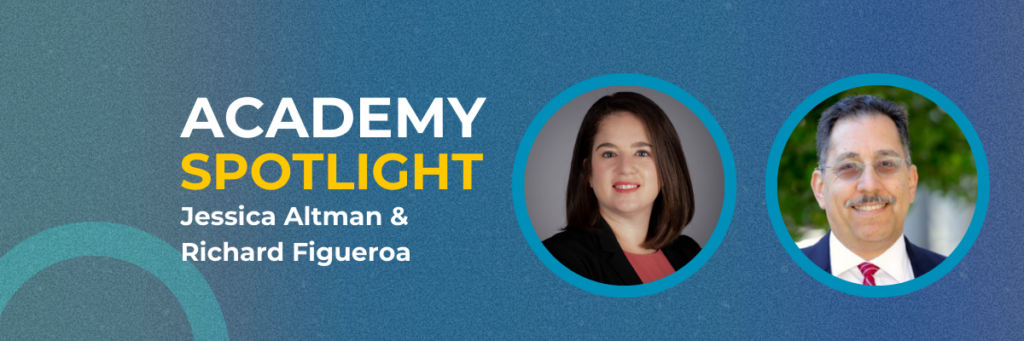
For Jessica Altman, Executive Director of Covered California, and Richard “Fig” Figueroa, Deputy Cabinet Secretary to California Governor Gavin Newsom, health policy isn’t just a profession; it’s personal. Both grew up immersed in conversations about access, community care, and the real-world impact of coverage gaps. Today, Altman and Fig advance California’s health goals from different vantage points — one leading the nation’s largest state-based marketplace, the other guiding policy and budget priorities from the governor’s office. In this Academy Spotlight, they reflect on the paths that drew them to health policy, the trade-offs behind major state decisions, and what they learn from colleagues across the country.
What early experience drew each of you to health policy, and how has that journey shaped the work you do today in service of Californians?
Jessica: Both my grandfathers were physicians; one a primary care family doctor, and the other an OB-GYN and one of the first abortion providers in the country when it was legalized. Both my parents worked in health care in different ways, and as an undergraduate, I was a public policy major concentrating in health care policy. I grew up around it. That gave me a view into really understanding the impact of access to health care, of having good health care, of the inequities that exist in our health care system, and put me on my path.
Fig: I’ve been interested in health care policy since a pretty young age; my parents were very interested in the community clinic movement, starting back in the ’60s. They came from immigrant families, and my dad was a steelworker, so he had labor union health coverage. They were interested in community-based care, so when a local community clinic opened in Oakland, California, they were one of the first joiners. I then realized there are a lot of people who don’t have coverage. It was part of my experience growing up, seeing the struggles in my community for health care, and so when I had an opportunity to assist on the state side, I jumped at the chance.
You both operate in very different parts of the health policy landscape. Jessica, you’re focused on coverage access and consumer experience, while Fig focuses on statewide policy direction and executive leadership. When California sets a health goal, how do those different roles show up in the day-to-day work of making it happen?
Jessica: We’re an independent entity in government, with a board that sets the overall direction, chaired by the HHS Secretary. That structure’s goal ensures we can move quickly and nimbly and be responsive to the environment but also stay aligned with broader statewide health initiatives.
Covered California is unique as a marketplace. We’re an active purchaser, meaning, fundamentally, health plans don’t have the right to be here. We decide whether they get to offer coverage to our members. So through the process of contracting and negotiating with our health plans, we can drive change in the health care system more broadly.
Fig: I help keep the trains running on time. I’m kind of a conduit between the governor and the various departments in the HHS Agency, so when the governor wants to investigate a new idea, either from the policy or budget perspective, and our agencies have ideas, regulations, or initiatives they want to propose, I’m the way station for information flowing between the governor to our various health and human services departments and vice versa. I also help them through internal policymaking and decision-making.
Health policy often comes down to tradeoffs rather than perfect solutions. Can you share an example where California had to make a difficult choice and how you decided what mattered most?
Jessica: This past year, marketplaces have seen the expiration of the enhanced premium tax credits, which is a big affordability impact to pretty much everyone who relies on Covered California for coverage, almost 2 million people. That meant we were losing $2.5 billion annually of federal funds to make health care more affordable. We’re also privileged to be one of the handful of states that has state funds to try to mitigate some of this, but we received $190 million. It’s a lot of money, and you can do great things with it, but it’s not $2.5 billion. We grappled with how to think about the best use of those funds in terms of the vulnerability of the population. We modeled a number of options and outlined those pros and cons, and ultimately, we made a decision on how to use those funds, thinking through those impacts.
Fig: Health policy is as much about health politics as it is about health policy. Everybody comes from a different point of view, and you have to interact with stakeholders to enact something. I’m very involved in the budget process, which is a manifestation of the governor’s priorities. Nested in that are a variety of decisions and trade-offs — not just within health care. The governor has to weigh education versus public safety, versus health and social services versus higher education and on and on. Within health care, there are choices like, “Do I want to fund some new initiative in public health versus our Medicaid program, versus services for older Californians, versus services for persons with intellectual and developmental disabilities? My role is to provide good information and data to help in that decision making process.
California is often looked to as a leader in implementing state health policies. Within NASHP’s Academy, where do you find the most value in learning from other states rather than leading the conversation?
Jessica: We love to lead, but we’re not leading on everything all at once, and we have lots to learn from our state colleagues. I love hearing how programs that in some ways are very different than ours — but where the goals are generally the same — are approaching this work. What things happening in other states that we could think about, to continue pushing the envelope here in California?
Fig: California is a leader, but if someone else has a good idea, we’re not shy about looking at it and seeing if it’s applicable. We wouldn’t be involved in NASHP unless we thought we could learn from our siblings in other states. Our Office of Health Care Affordability has an overall health care spending target. Well, we looked at Maryland and Massachusetts and others as leaders in this part of the health policy sphere. So, we’re able to draw upon that experience of these other states to help craft our own. And that’s just one of many examples. States are laboratories, red states and blue states alike, and we can learn from all of them.
Given California’s scale and leadership role, what have you heard at one of NASHP’s convenings, meetings, or annual conferences that made you pause or think differently about an issue back home?
Jessica: There are often assumptions made about how the politics of a state shape what’s possible. I’ve experienced that in my own way, moving from Pennsylvania and anything needing to be bipartisan to get done successfully, versus coming to California, which is a different picture. I love hearing public servants across states of any sort of political persuasion, doing good work. Hearing creative ways people have been able to really get the buy-in from their state and leadership to do things you might not guess.
Fig: We have looked at what other states have done in terms of drug purchasing and relied on NASHP’s technical assistance to do what we call CalRx in California. You have national organizations that focus on health policy from a legislative angle, a governor’s angle, or an insurance commissioner’s angle, for example. What NASHP does is pull from all of those. So, it’s a unique combination of individuals I would never have otherwise been able to meet.
What do you enjoy most about state health policy?
Jessica: People who are in state health care policy deeply care about what we’re doing, about each other. I love the fact that for any problem I have, I have someone in my phone I can text and ask, how do you handle this? In our world, it’s much more about being competitive in a “we want to do something first, so that we can help everybody else do things” kind of way, that is just so beautifully collaborative and mission-driven.
Fig: It’s a very dynamic field; you never know what’s coming at you, and there’s always a lot to learn. I’ve been very blessed to have the kind of jobs that I’ve had in government. Even though I’m not a decision-maker, I work for those that do, and I can at least provide a good basis of information for them to make the best possible decision they can, given the trade-offs they have to make.
For students and early-career professionals interested in pursuing health policy, what skills, experiences, or mindsets do you believe are most important to develop, and what do you wish you had known earlier in your own careers?
Jessica: You need passion and problem-solving skills. This work is hard, and it takes a constant reminder of what you’re trying to achieve. Even though there are problems, you have also made progress and made a difference throughout your career and influence to keep in the fight for this work.
In any job, the more problems, the more it matters that you can be a problem solver. We always need problem solvers in health care.
Fig: Do as much reading as you can about health policy. The field is so huge and dynamic. Keep an open mind about where your path may lead, because you’re always learning and building knowledge. In my career, I’ve always asked myself, what can I do now to prepare for something I might want to do two, three, or four years down the road? Don’t be afraid to take a chance. You’re not always going to be successful, but you don’t know unless you try.