

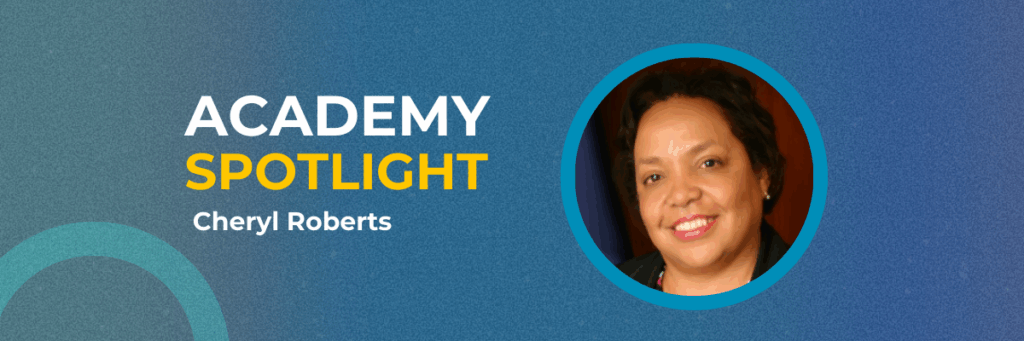
This series is part of a spotlight on members of NASHP’s Academy, showcasing the expertise and leadership they bring to advancing state health policy. Each feature offers a closer look at their work and the meaningful contributions they make to NASHP’s mission.
Cheryl Roberts, Director of Virginia’s Department of Medical Assistance Services, has spent her career moving from implementing decisions behind the scenes to shaping strategy at the highest level. In this Q&A, Roberts shares how she found her calling in health policy, what she’s learned about turning vision into action, and why listening to communities and the next generation of leaders keeps her energized.
What first pulled you into health policy, and how did that lead to your current role?
When I began my career at New York Life Insurance, I was originally on the claims and IT side. Over time, I moved into policy, program development, and operations when I transitioned to what is now EmblemHealth. That was where I first heard someone speak about health policy and public service, and I felt an immediate pull.
I’m also a Medicaid kid, and that has shaped the way I see this work. I came to view it as my calling, to take the experience I had from the commercial side of health care and bring it to Medicaid. That perspective ultimately brought me to Virginia, where I was hired to help implement managed care.
My understanding of health policy really deepened through NASHP. Before that, I was living in something of a silo, focused mostly on operations and managed care. NASHP opened my eyes to the bigger picture, to the policy questions that shape our work. I can honestly say I wouldn’t have been prepared for this role, or understood it as I do now, without that experience.
How has your perspective on policy and operations in state government evolved?
For much of my career, my work was in a secondary role; carrying out someone else’s decisions. I valued that work, and I still do, but now I also have responsibility for setting the vision and the strategy that guide those decisions.
What I’ve come to understand is that policy, operations, and politics are inseparable. I think what makes me a little different is the ability to hold both the vision and the practical realities at the same time. I can speak to where we want to go, but I also think critically about whether it’s doable. That balance matters.
What’s a recent project or decision in Virginia’s Medicaid program that gave you optimism?
One example is our work to expand adult dental benefits. It was a major priority, and we secured funding, General Assembly approval, and support from the governor. The challenge, though, was that the resources were limited; we couldn’t provide unlimited services.
We had a choice: implement the program in a way that would bankrupt it from the start, or find a smarter path. We chose the latter. My team and I brought dentists together and asked them to help us figure out how to design a sustainable benefit package within the resources we had. The result was a program that was not only viable but responsive to people’s needs. That kind of collaboration gives me a lot of optimism.
What’s one aspect of Medicaid you wish more people understood?
The stigma. Too often people — including providers — have a stereotype in their minds of what a Medicaid member looks like. In reality, especially in an expansion state like Virginia, it’s the person who checks out your groceries or bags your items at TJ Maxx.
When I talk with providers about participating in Medicaid, some imagine their patients will be “difficult.” But the truth is, Medicaid members are often young adults working multiple part-time jobs, or the college student tutoring your children. I wish more people could hear and see their stories because they reflect the everyday lives of our communities.
What approaches hold the most promise for improving maternal health outcomes in Virginia?
Virginia faces both geographic disparities, particularly in rural areas, and racial disparities. The governor asked us to focus specifically on postpartum care, and my team committed themselves for more than a year to turning those outcomes around.
One issue we identified was that hospitals weren’t scheduling postpartum visits before discharge, which meant those visits often never happened. By getting hospitals to change that practice, we saw immediate improvements.
We also looked at access barriers. For example, in Petersburg, which had some of the worst outcomes, I worked with a physician willing to open Saturday clinics. For many Medicaid members, taking time off during the week isn’t realistic. Once we made postpartum care available on Saturdays, and encouraged health plans to assist participation increased significantly. Today, Petersburg is no longer at the bottom for postpartum and prenatal care. And two other health systems in Virginia are offering after hour care. That’s the kind of practical, community-driven solution that changes lives.
You just wrapped up your rural transformation session tours — what surprised you most about Virginia’s rural communities?
Traveling across the state in that way was eye-opening. It also forced me to confront some of my own assumptions. What struck me most was how deeply people in rural communities support one another and take pride in their connections.
In some ways, I think cities could be envious of that closeness. In urban areas, it’s easy to become numb to community ties, but in rural Virginia, people came out, spoke up, and showed how much they care about making a difference. That energy and commitment stayed with me.
What was your biggest takeaway from NASHP’s annual conference this year?
For me, the greatest source of energy at NASHP conferences is always the younger professionals. I call it my “IV therapy.” Their enthusiasm, hope, and fresh perspectives remind me of the promise in this work.
That’s why you’ll often find me talking with early-career professionals. They are the future of health policy, and their excitement fuels me.
What wisdom would you share with those starting out in public service or health policy?
First, recognize the “CEO” of your career. That means building three things: vision and strategy, the ability to execute tasks reliably, and the skill of cultivating relationships and maintaining them over time.
Second, in your early years, focus less on chasing titles and more on building skill sets. Ask yourself: What skills am I gaining in this role that I can carry forward? Those skills are the most valuable thing you’ll take with you, wherever your path leads.