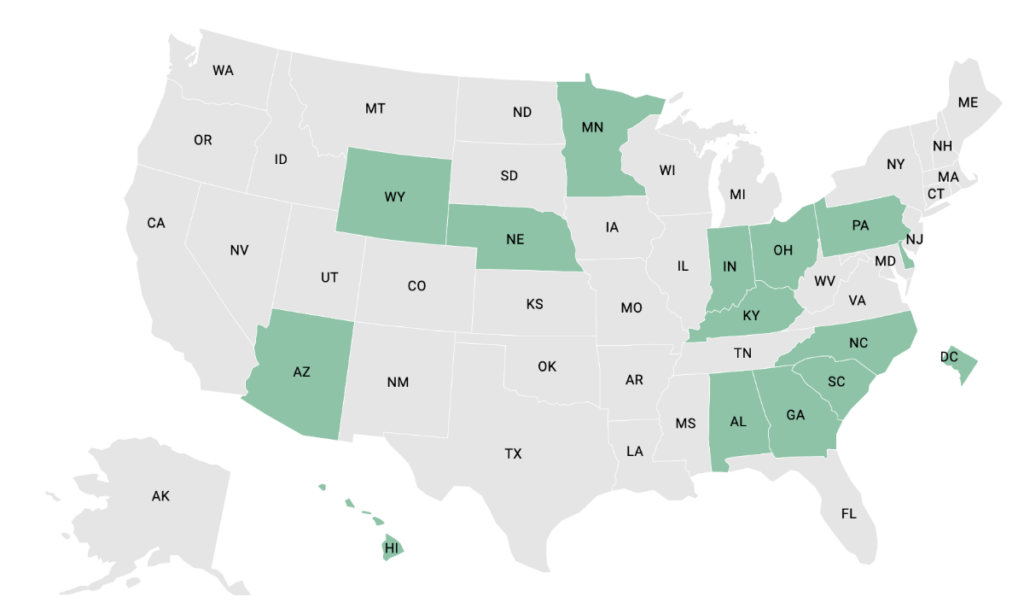

This information was collected through a combination of state surveys and NASHP staff research. It offers a snapshot of how the state is defining, training, certifying, and paying for the CHW workforce — as well as how the state is developing cross-agency and state-to-local strategies to improve community health in partnership with CHWs.
This is a dynamic policy space, and states are continuing to develop new approaches. We will continue to make periodic updates to this page. Learn more about state CHW policies across the U.S.
State CHW Definition
The Virginia CHW Advisory Group created the following definition that is also used by the Virginia Department of Health(VDH): “Individual(s) who (i) applies his(her) unique understanding of the experience, language, and culture of the populations he(she) serves to promote healthy living and to help people take greater control over their health and lives and (ii) is trained to work in a variety of community settings, partnering in the delivery of health and human services to carry out one or more of the following roles: (a) providing culturally appropriate health education and information; (b) linking people to direct service providers, including informal counseling; (c) advocating for individual and community needs, including identification of gaps and existing strengths, and actively building individual and community capacity.”
State CHW Governance
Virginia does not have a dedicated state office of CHWs.
Certification and Training
Virginia supports voluntary certification of CHWs through the Virginia Certification Board. The Virginia Department of Health, Virginia CHW Workforce Development Council, and Virginia CHW Association collaborated to develop criteria for entities that seek to provide CHW training in Virginia. The Virginia Certification Board serves as the accrediting body for providers of CHW training curricula. Currently, there are 11 approved certified CHW training providers in Virginia.
Medicaid Reimbursement
Virginia does not reimburse for CHW services through its Medicaid program.
Other Funding or Financing Mechanisms
In its 2025 state budget bill, Virginia appropriated $3.2 million for 2025 and $3.2 million for 2026 to support CHW positions at Virginia’s local health districts. Funding priority will be given to CHW positions at health districts serving localities with the highest rates of maternal mortality. The funding will support the employment of 31 CHWs among 20 local health districts.
In 2021, the Institute for Public Health Innovation (IPHI) received funding from the Centers for Disease Control and Prevention’s (CDC’s) Community Health Workers for COVID Response and Resilient Communities initiative to expand and support CHW presence in four regions of Virginia in response to COVID-19 through February 2025. In 2022, the Virginia Department of Health (VDH) received HRSA-22-124 funding for CHW training programs, which provides funding for training new CHWs in Virginia and placing CHWs into apprenticeships through September 2025. In 2023, VDH received funding from the CDC National Cardiovascular Health Program and the Innovative Cardiovascular HealthProgram to focus on Virginia census tracts with the highest hypertension prevalence and the lowest health opportunity. As part of VDH’s strategy for these grants, CHWs have been hired to work in the following CDC-required strategic areas through September 2028:
- Community: Focuses on grassroots engagement of people at the neighborhood level. Ongoing peer support and screening referrals, whether received by clinic/hospital or in the community. Participates in the Learning Collaborative.
- Clinic: Serves as a member of the clinical team, maintaining the role of a CHW. Patients are referred to the CHW. Medicare reimbursement through Chronic Care Management service. Currently testing internal/external CHW models.
- Hospital: Serves as the referral resource on the hospital’s community health hub. Can be placed in the emergency department, physical building, or community. Uses referral screening tools and platforms (e.g. Unite Us, Charity Tracker).
Key Partnerships
Key partners in certifying, training, and supporting the CHW workforce include the Virginia CHW Association and Virginia CHW Workforce Development Council. Other key partners include Urban Baby Beginnings, Transformative Change, Virginia Hospital and Healthcare Foundation, ImPAct Care, Central Virginia Health Services, Virginia Healthcare Association, Health Brigade, Mount Rogers Health District, Richmond/Henrico Health District, Sacred Heart, and PATHS Inc.
State CHW Legislation
HB 688 was approved in 2020, giving the Department of Health authority to promulgate CHW certification. Draft CHW certification regulations are currently under review by the Office of the Governor.
State Resources
ACO – Accountable care organization
AHEC – Area Health Education Centers
APHA – American Public Health Association
APM – Alternative payment model
CBO – Community-based organization
CDC – Centers for Disease Control and Prevention
CDC CCR Funding – Community Health Workers for COVID Response and Resilient Communities Funding
CHR – Community health representative
CHW – Community health worker
CPT Codes – Current Procedural Terminology Codes
C3 Project – CHW Core Competency Project
FFS – Fee for services
HCSPCS Codes – Healthcare Common Procedure Coding System Codes
HRSA – Health Resources & Services Administration
MCO – Managed care organization
NACHW – National Association of Community Health Workers
SDOH – Social determinants of health
VBP – Value-based payment
State CHW Definition: This category indicates where states have a formal definition of a CHW. In some cases, where there is not a definition in statute, this category may draw information from provider manuals and state websites or reports.
Certification and Training: This category includes information about how CHWs are trained in the state, which entities provide training, whether or not the state runs or recognizes a CHW certification program, and information about the entities that administer existing certification programs.
Medicaid Reimbursement: This category includes information about state Medicaid strategies that provide enrollees access to CHW services. Entries indicate whether state Medicaid programs currently reimburse for CHW services or incorporate CHWs into alternative payment models under the authority of a state plan amendment (SPA), or where states have earmarked funds to support CHW services under the authority of an 1115 demonstration waiver. It also indicates where CHW services might be supported through managed care approaches (e.g., where MCOs are paying for CHW services using administrative dollars or where states are using managed care contracts to incentivize or require MCOs to cover CHW services).
Other Funding or Financing Mechanisms: This category includes information about other state funding or financing approaches that cover CHW services or CHW positions. It includes information about federal grant dollars for which the state is the grantee.
Key Partnerships: This category offers information about key partners outside state government, including state CHW associations and CHW training entities, and highlights formal cross-agency partnerships within the state that support alignment of funding and resources for the CHW workforce.
State CHW Legislation: This category highlights any state legislation relevant to the CHW workforce. This might include statutory language directing agencies to develop a Medicaid reimbursement approach, laws that established state CHW certification, or other relevant statutes.
State Resources: This category offers links to any key reports or resources that states elected to highlight as critical to CHW policy and partnership.