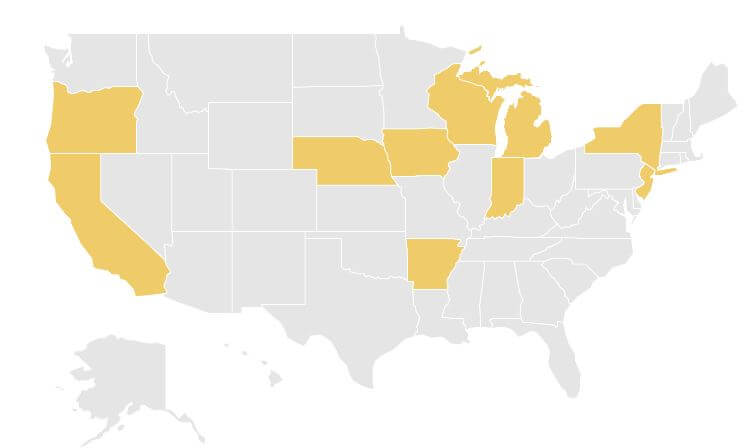

This information was collected through a combination of state surveys and NASHP staff research. It offers a snapshot of how the state is defining, training, certifying, and paying for the CHW workforce — as well as how the state is developing cross-agency and state-to-local strategies to improve community health in partnership with CHWs.
This is a dynamic policy space, and states are continuing to develop new approaches. We will continue to make periodic updates to this page. Learn more about state CHW policies across the U.S.
State CHW Definition
State CHW Governance
Michigan does not have a dedicated state office of CHWs. The Michigan Department of Health and Human Services Policy and Planning SDOH team works to support the state CHW workforces and implement recommendations from the CHW Subcommittee.
Certification and Training
The CHW Advisory Committee is advising the Department of Health on the development on a formal certification policy. For reimbursement eligibility through the Medicaid State Plan, individuals must have completed a CHW training program approved by the Michigan Department of Health and Human Services that aligns with the National Council on CHW Core Consensus Standards (National C3 Council).
Medicaid Health Plan contracts currently define the required basic core competencies in which CHWs must be trained. Health home models and other care team models that include CHWs require training but do not specify a curriculum or certification.
During the initial 24 months of Medicaid policy implementation (from January 1, 2024, to December 31, 2025), an individual who does not possess the CHW Training Program Pathway qualifications will be permitted to temporarily deliver CHW services and seek reimbursement through Medicaid via workforce experience.
Medicaid Reimbursement
Michigan Medicaid reimburses for CHW services under its State Plan, which was approved by CMS in October 2023. In October 2024, Medicaid policy was issued to establish coverage criteria for CHW services as a component of Medicaid services effective for dates of service on and after January 1, 2024.
Medicaid health plans (MHPs) are required to employ CHWs at a ratio of 1:5,000 members. These CHWs may be hired by the MHP or contracted out to a community-based organization or clinical setting. To incentivize CHWs working in community, the state counts CHWs employed by clinics or CBOs as 1.25 FTEs for purposes of the ratio calculation.
Michigan Medicaid reimburses for team-based care models, including health homes and targeted case management for recently incarcerated individuals that allow CHW service delivery. The health home model is reimbursed through a service bundle code that is billed monthly. The billing/coding model is not specific to CHW services; CHW and peer support services may be delivered as a part of these and other care team models.
Other Funding or Financing Mechanisms
In their 2024 appropriations, Michigan allocated $325,000 for community health worker career centers. These are appropriated to local school districts to fund ongoing efforts in CHW certification programs.
The MiCOACH program through the Michigan Department of Labor and Economic Opportunity seeks to coach and mentor graduating high school students from the 10 most under-resourced high schools in the state to enter CHW behavioral health career pathway. Additionally, an initiative through the Michigan Center for Rural Health works to integrate CHWs into rural communities.
Key Partnerships
The MDHHS Social Determinants of Health (SDOH) Strategy identified CHWs as one of four strategic interventions to advance health equity and improve health outcomes in the state. Through the SDOH Strategy, a CHW subcommittee was established, and a CHW Internal Alignment Work Group provides ongoing, accessible opportunities for community engagement to ensure the work is informed and driven by communities.
The Michigan Community Health Worker Alliance (MiCHWA) is an information hub that promotes and sustains the integration of CHWs into health and human services organizations throughout Michigan. MiCHWA, in partnership with the Michigan Primary Care Association, is the designated vendor to provide verification and credentialing services for CHWs seeking Medicaid reimbursement in Michigan. MiCHWA is responsible for the implementation and maintenance of the MI Medicaid CHW Registry, a database of CHWs who have met qualification criteria required to provide CHW services to Medicaid beneficiaries in Michigan. MiCHWA also facilitates the review and approval of CHW training programs for inclusion to the MI Medicaid CHW Registry-Approved Training Programs list.
State CHW Legislation
Michigan’s fiscal year 2023 omnibus budget bill included language requiring the state to “seek federal authority to formally enroll and recognize community health workers as providers and to utilize Medicaid matching funds for community health worker services, including the potential of leveraging of a Medicaid state plan amendment, waiver authorities, or other means to secure financing for community health worker services.”
State Resources
- Community Health Workers (Michigan Medicaid CHW Services website)
- Michigan Medicaid Provider Manual
- Recorded webinars on the Michigan Medicaid Providers Training webpage
- MDHHS SDOH Strategy Community Health Worker
- Michigan Community Health Worker Alliance (MiCHWA)
ACO – Accountable care organization
AHEC – Area Health Education Centers
APHA – American Public Health Association
APM – Alternative payment model
CBO – Community-based organization
CDC – Centers for Disease Control and Prevention
CDC CCR Funding – Community Health Workers for COVID Response and Resilient Communities Funding
CHR – Community health representative
CHW – Community health worker
CPT Codes – Current Procedural Terminology Codes
C3 Project – CHW Core Competency Project
FFS – Fee for services
HCSPCS Codes – Healthcare Common Procedure Coding System Codes
HRSA – Health Resources & Services Administration
MCO – Managed care organization
NACHW – National Association of Community Health Workers
SDOH – Social determinants of health
VBP – Value-based payment
State CHW Definition: This category indicates where states have a formal definition of a CHW. In some cases, where there is not a definition in statute, this category may draw information from provider manuals and state websites or reports.
Certification and Training: This category includes information about how CHWs are trained in the state, which entities provide training, whether or not the state runs or recognizes a CHW certification program, and information about the entities that administer existing certification programs.
Medicaid Reimbursement: This category includes information about state Medicaid strategies that provide enrollees access to CHW services. Entries indicate whether state Medicaid programs currently reimburse for CHW services or incorporate CHWs into alternative payment models under the authority of a state plan amendment (SPA), or where states have earmarked funds to support CHW services under the authority of an 1115 demonstration waiver. It also indicates where CHW services might be supported through managed care approaches (e.g., where MCOs are paying for CHW services using administrative dollars or where states are using managed care contracts to incentivize or require MCOs to cover CHW services).
Other Funding or Financing Mechanisms: This category includes information about other state funding or financing approaches that cover CHW services or CHW positions. It includes information about federal grant dollars for which the state is the grantee.
Key Partnerships: This category offers information about key partners outside state government, including state CHW associations and CHW training entities, and highlights formal cross-agency partnerships within the state that support alignment of funding and resources for the CHW workforce.
State CHW Legislation: This category highlights any state legislation relevant to the CHW workforce. This might include statutory language directing agencies to develop a Medicaid reimbursement approach, laws that established state CHW certification, or other relevant statutes.
State Resources: This category offers links to any key reports or resources that states elected to highlight as critical to CHW policy and partnership.